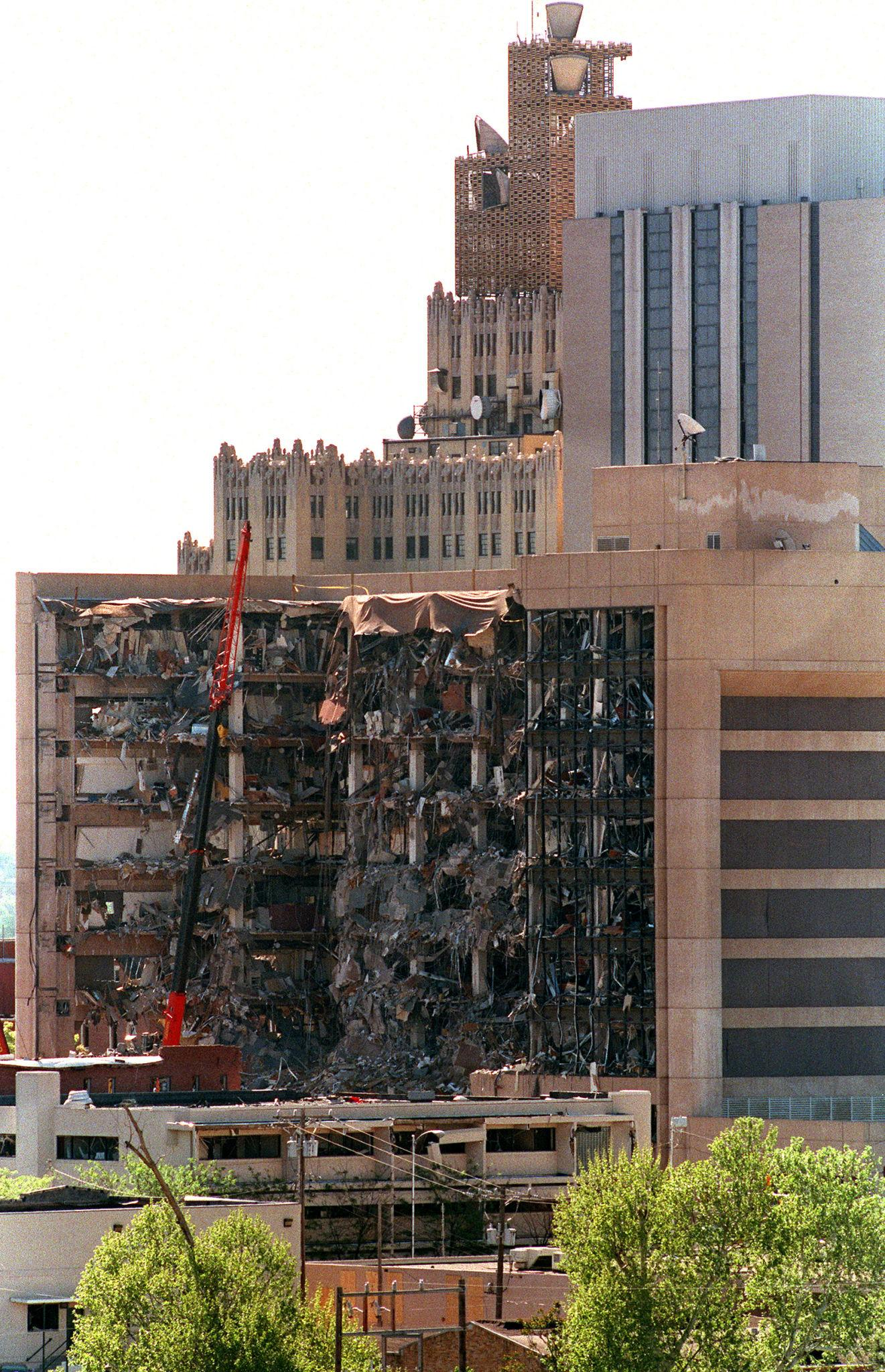
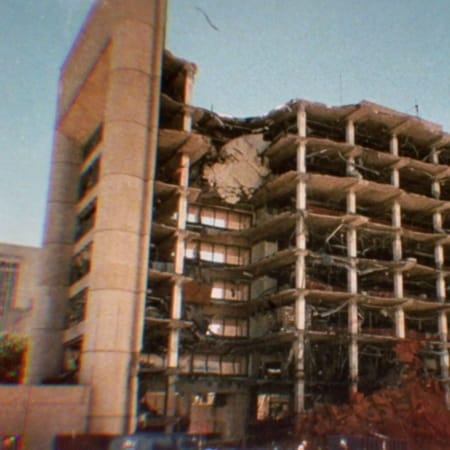
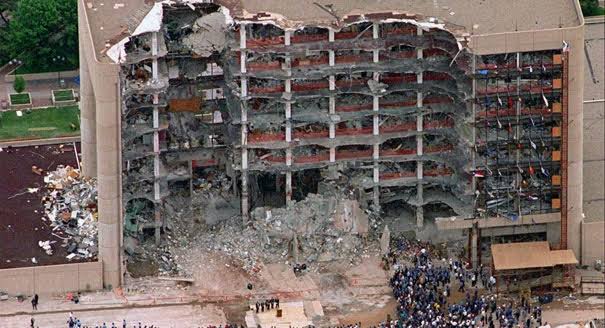
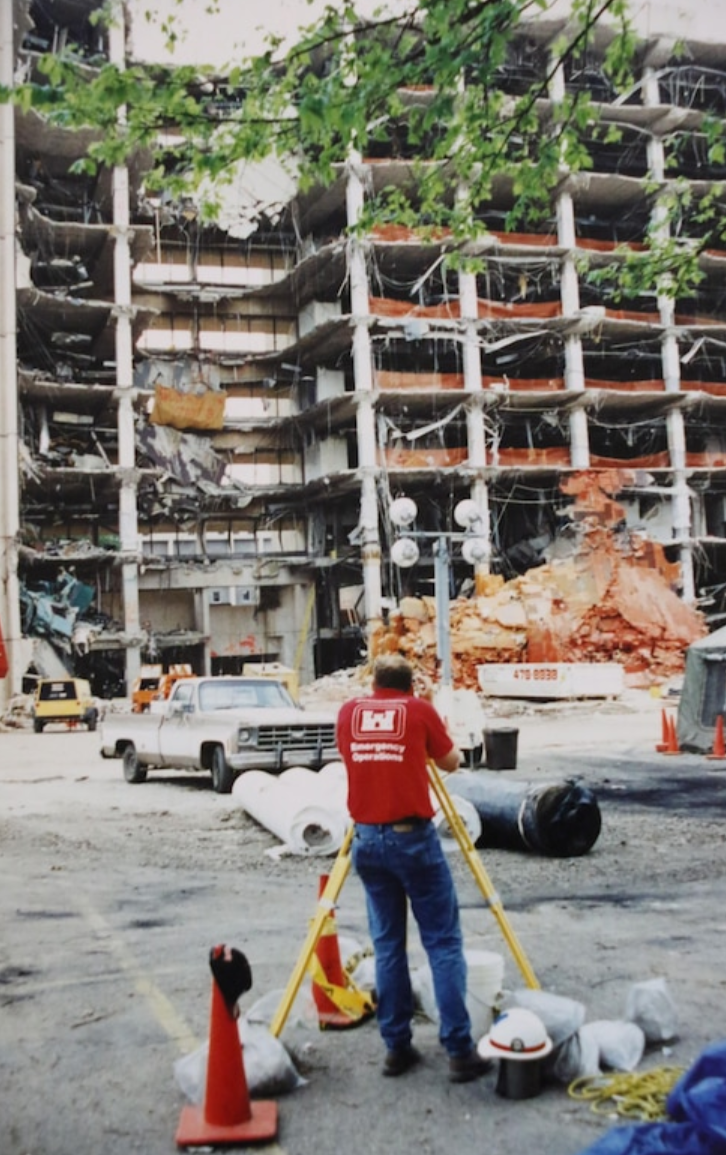
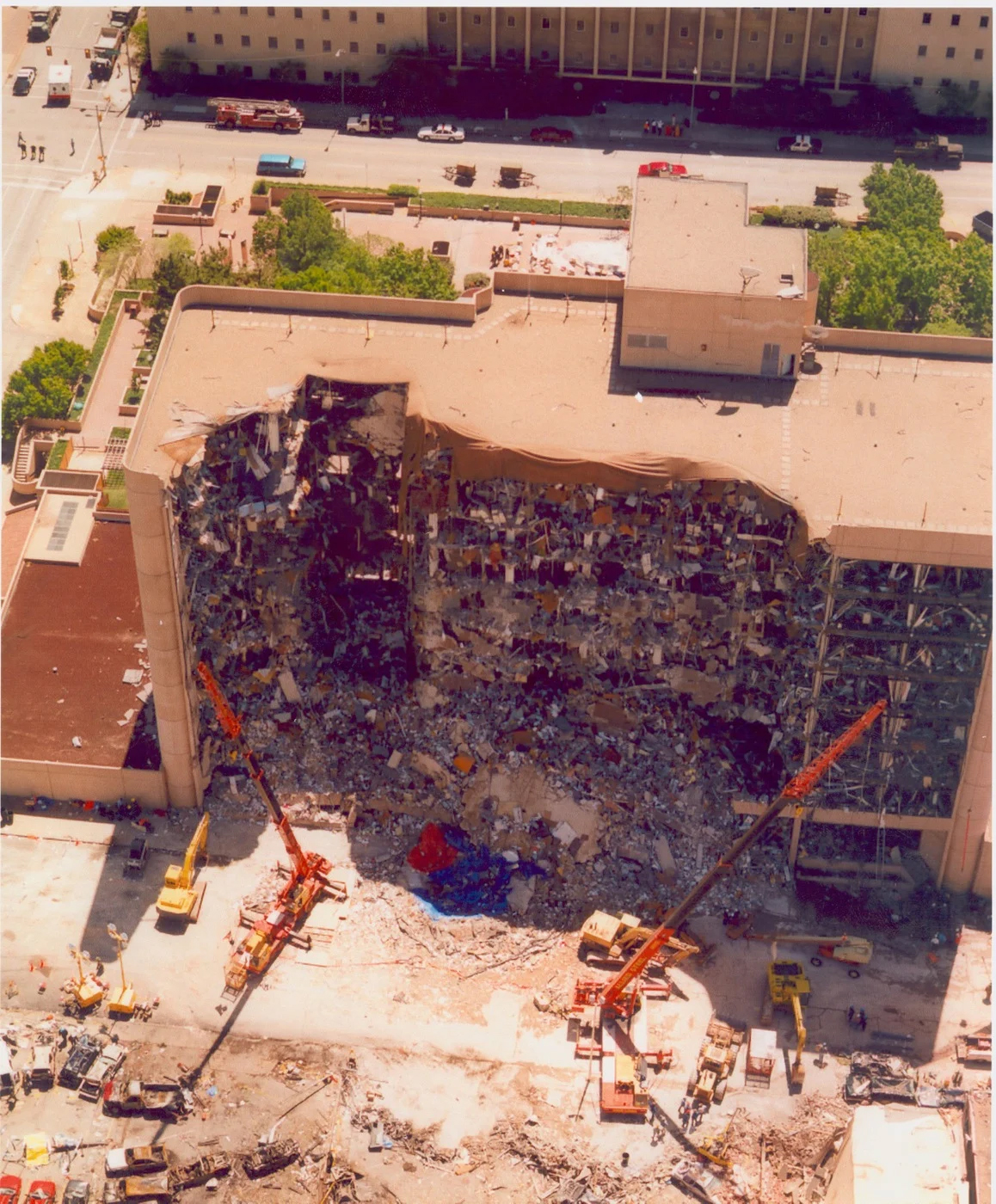
Today, another building has been opened from the side.
Its offices have become cross-sections. Floors hang over nothing. Desks, lights, pipes, filing cabinets, concrete, wire, paper, glass, and pieces of ordinary work remain visible inside rooms that no longer have an outside wall.
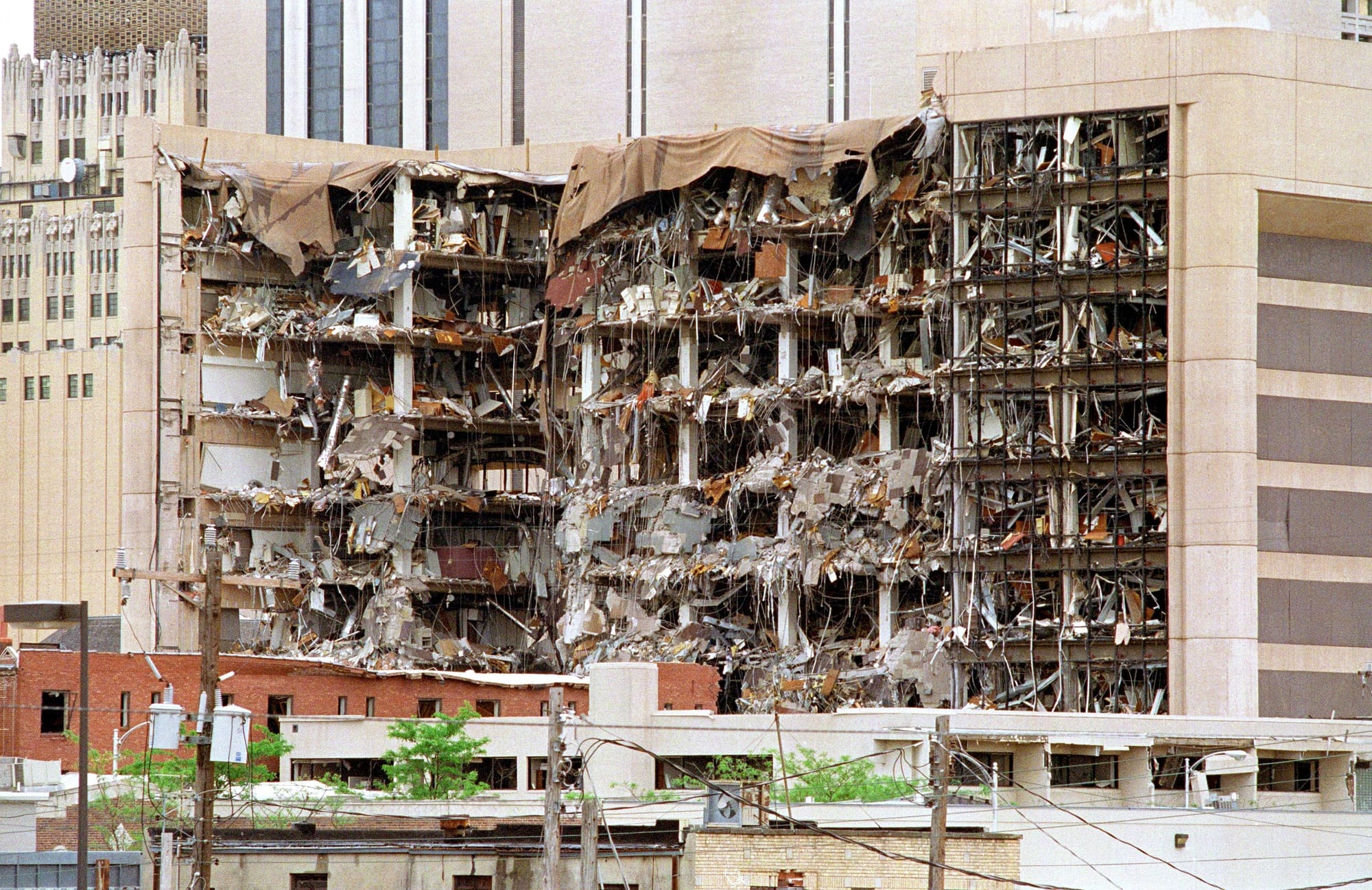
The building looks almost anatomical now.
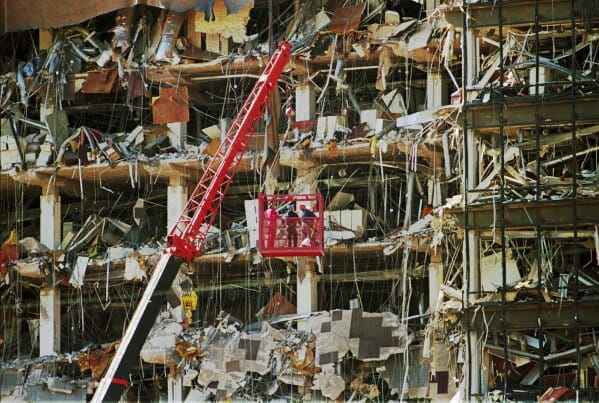
It has been cut open deeply enough to reveal what was inside.
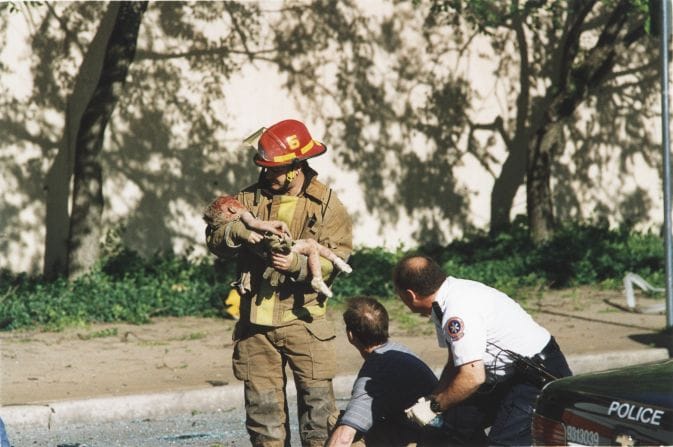
People.
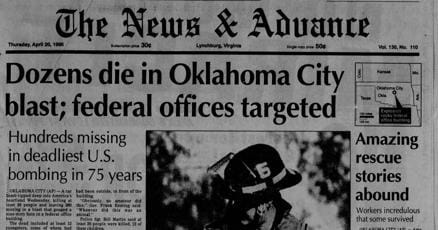
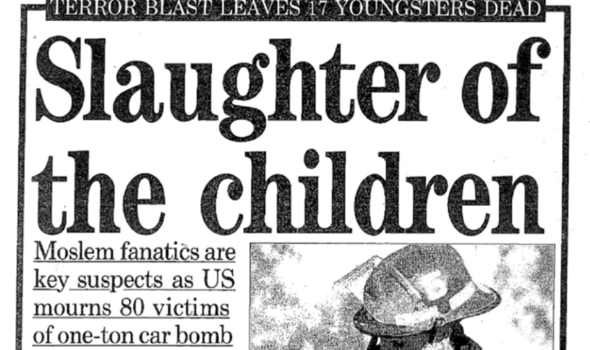
At 9:02 on the morning of April 19, 1995, a bomb inside a rented Ryder truck detonated in front of the Alfred P. Murrah Federal Building in Oklahoma City.
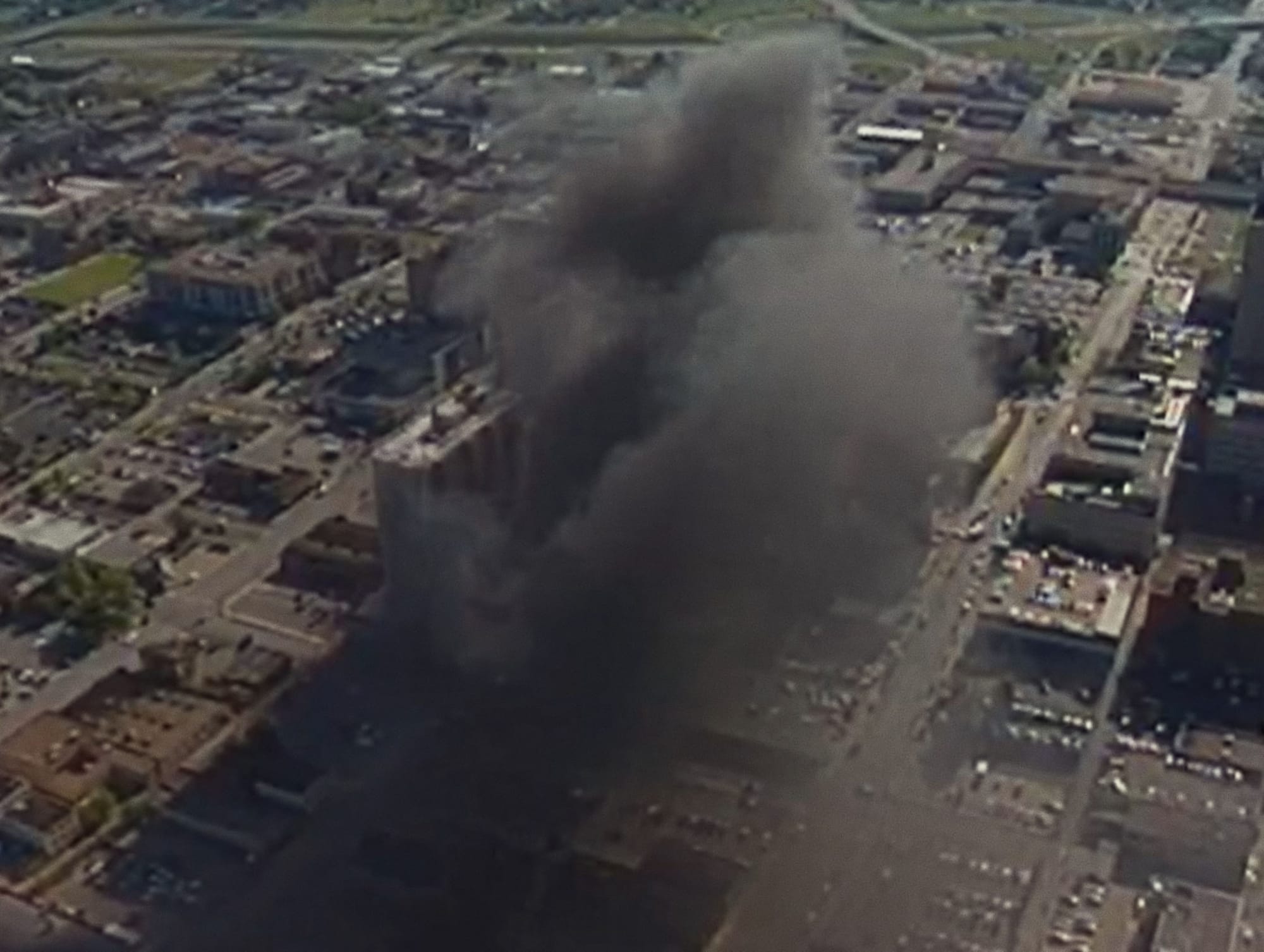
A third of the building collapsed.
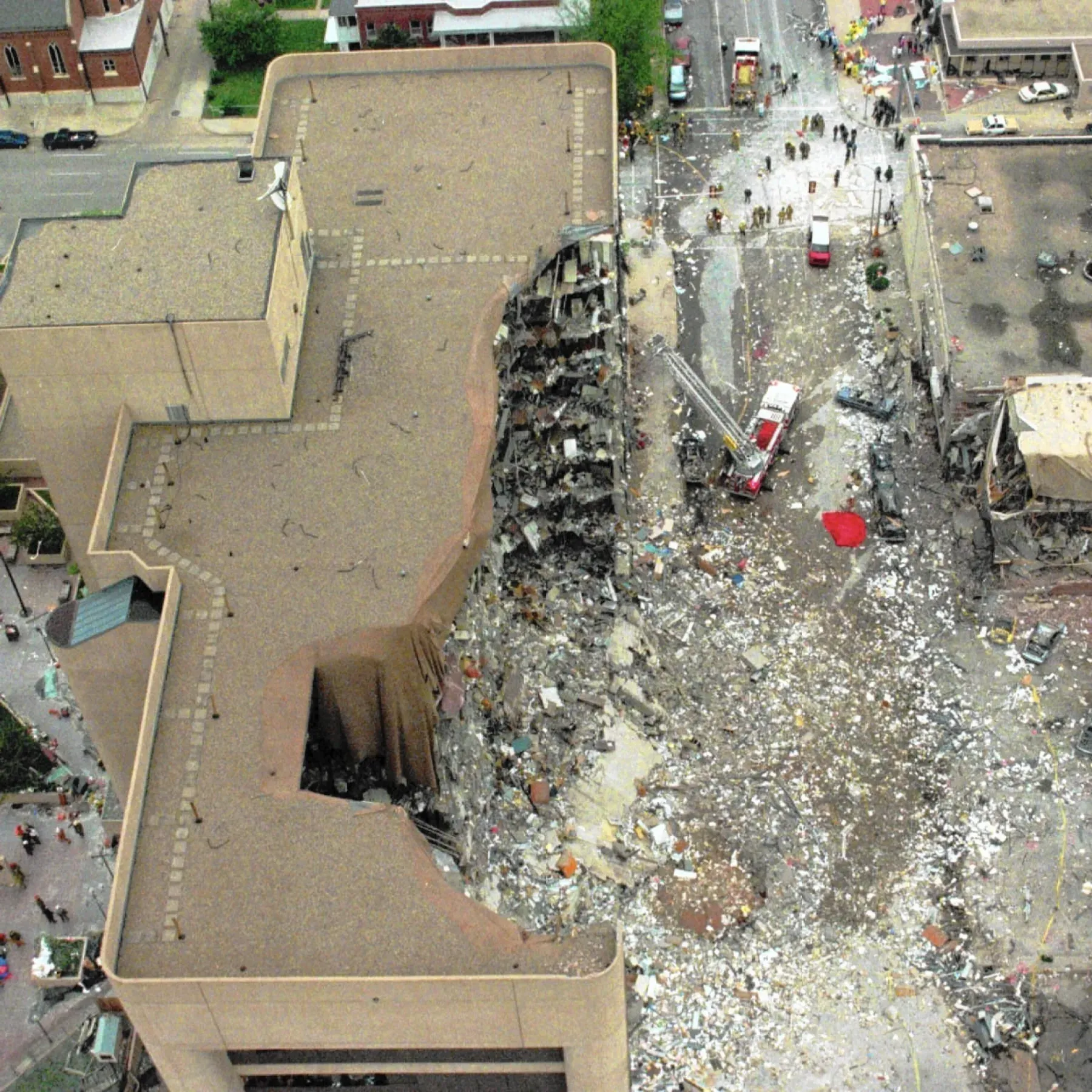
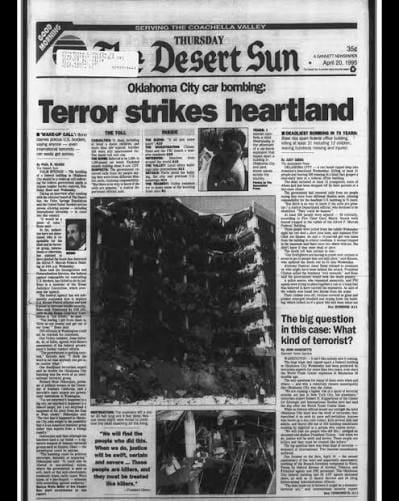
The blast killed 168 people. Nineteen were children.
Hundreds more were injured. Nearby buildings broke open. Cars burned. Rescue workers entered a field of unstable concrete, hanging steel, severed utilities, human remains, trapped survivors, frightened families, emergency radio traffic, blood supply requests, improvised triage, and the rapidly expanding knowledge that whatever had happened here was much larger than the front of one federal building.
Timothy McVeigh had selected the building because it represented the federal government.
The building did contain federal offices.
That part of his analysis was extremely easy.
The building also contained workers arriving for another Wednesday, citizens trying to reach public services, families dependent on those workers, visitors with appointments, people passing through the surrounding streets, and children entering the America’s Kids Day Care Center.
That was the field McVeigh had removed from his analysis.
He saw the federal building. Then, he made everyone inside it become federal.
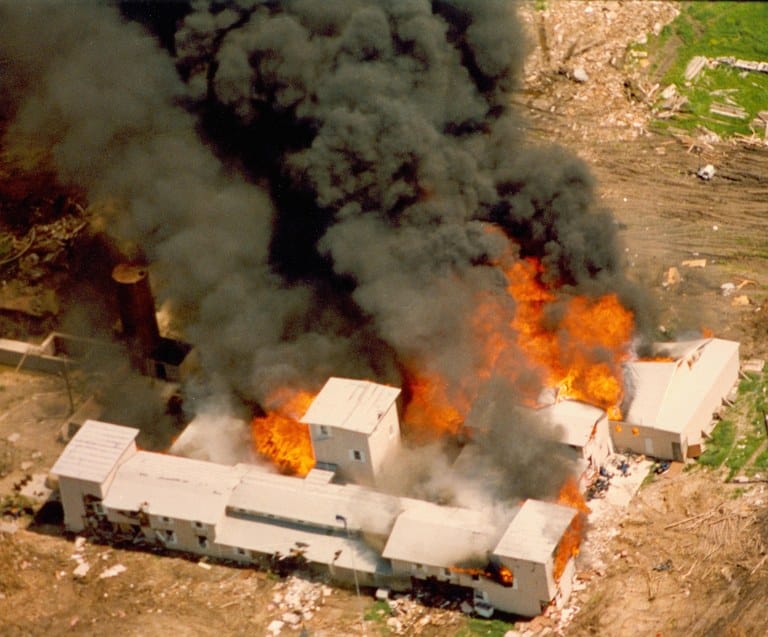
Two years earlier, on the same date, the Branch Davidian compound at Mount Carmel burned outside Waco, Texas.
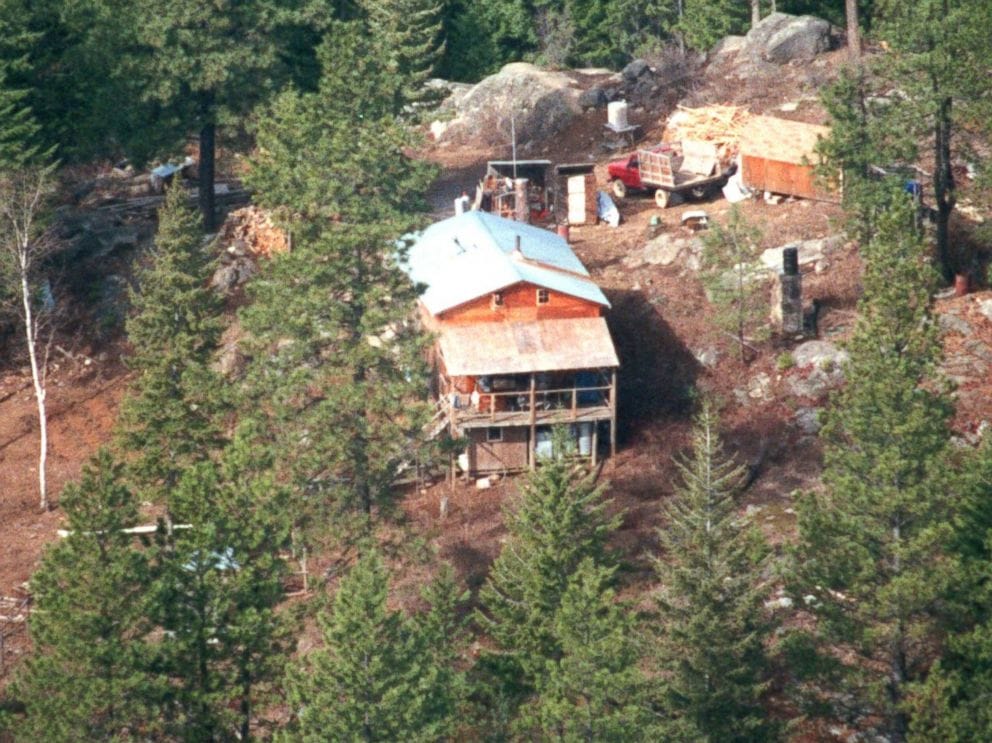
Eight months before Waco, a cabin on an Idaho mountain had become the center of an armed federal siege remembered as Ruby Ridge.
McVeigh had drawn a line through these three places.
He understood the first two as acts of federal war against American citizens. He understood the third as an answer.
That line was his field analysis.
The bomb was his repair theory.
Nothing was repaired here.
That sentence still marks the failed field analyst.
But McVeigh presents this series with a harder case than Anthony Warner did in Nashville.

Warner detected a real network node and detonated his private mythology into it. McVeigh also selected a symbolic node, but the grievances he carried into Oklahoma City did not originate entirely inside his imagination.
The federal government did convert lawful problems into siege fields. It did build decision systems that compressed uncertain human behavior into tactical categories. It did authorize actions that closed surrender paths, destroyed trust, and killed people whom state power was obligated to preserve.
The state did not need to be innocent for McVeigh to lack title.
No wound grants sovereignty over the field.
A failed field analyst is dangerous precisely because some part of the analysis is true.
McVeigh saw that state violence could become self-protecting.
He saw that official authority could convert an error into a warrant, a warrant into an operation, an operation into a battlefield, and a battlefield into its own justification.
He saw that law-enforcement institutions could describe the field in categories that made escalation appear compulsory.
Each category can reveal something real.
Each category can also reduce the number of living distinctions the institution remains able to perceive.
McVeigh saw that a state may begin with legitimate authority and still travel into illegitimate force. Correct.
He saw that institutions investigate their own conduct through instruments those institutions already control. Correct again.
He saw that the government’s public account of an operation may preserve its authority more successfully than it preserves the people harmed by its decisions.
Yes. That danger is also very real.
Then, McVeigh failed every analytical test that followed.
Timothy McVeigh saw the Retaliation Machine. Then he climbed right inside.
Before this article can reconstruct that failure, it has to return to the scenes McVeigh claimed to answer. These wounds must be taken away from him and restored to their actual field.
An arrest warrant is a path.
It is an instrument by which a state attempts to move a person from one legal condition into another.
That is the intended route.
A warrant does not contain a siege.
It does not contain a sniper.
It does not contain an armored vehicle, a dead child, a burning building, or a national trauma.
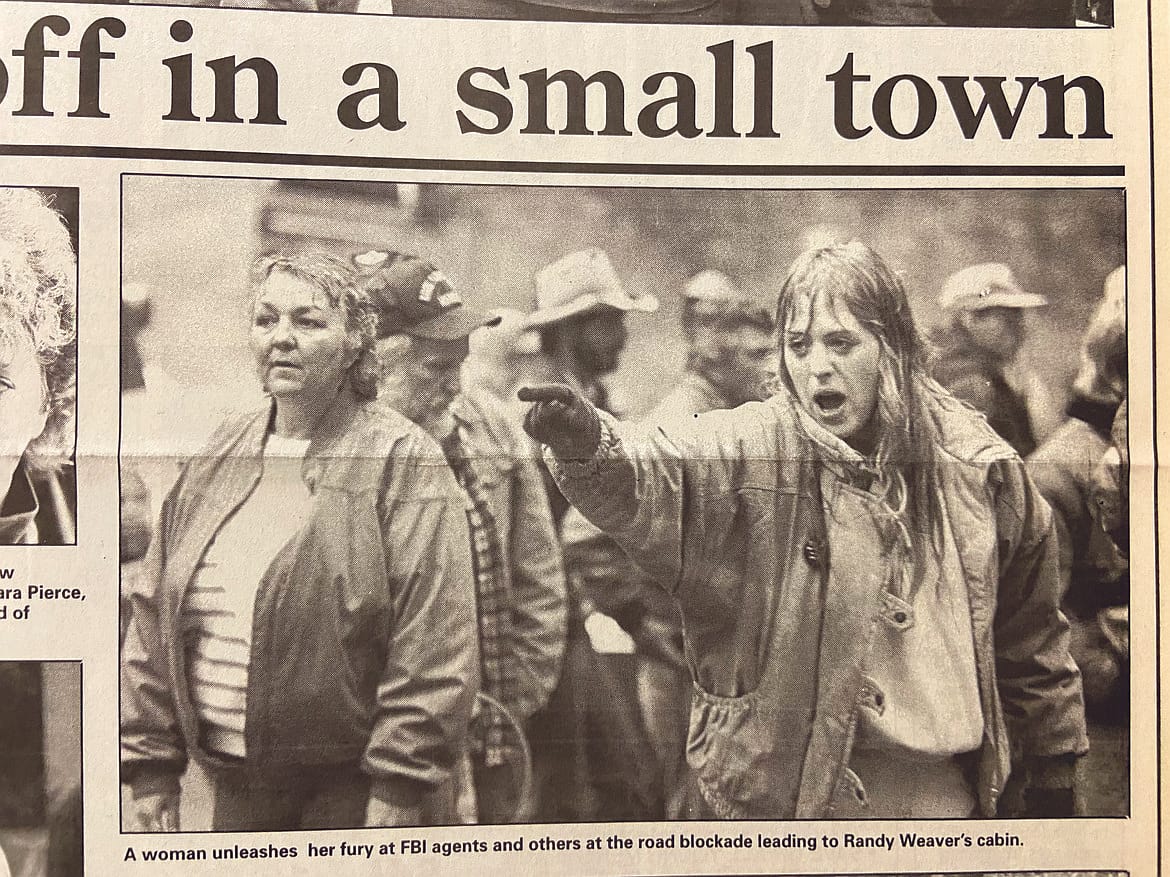
Those things enter through later decisions.
The state often narrates these events backward. Once the field has become violent, every earlier step is interpreted through the final danger. The original subject was armed; therefore the surveillance was necessary. The surveillance produced confrontation; therefore tactical escalation was necessary. Escalation produced resistance; therefore extraordinary force was necessary. The final scene then travels backward through the chain and certifies every decision that helped produce it.
Modal Path Ethics has to reconstruct the pipeline forward.
At each transition, other paths were still reachable.
And at each transition, somebody made the field narrower.
Randy Weaver was not an innocent forest hermit whom the federal government selected at random.
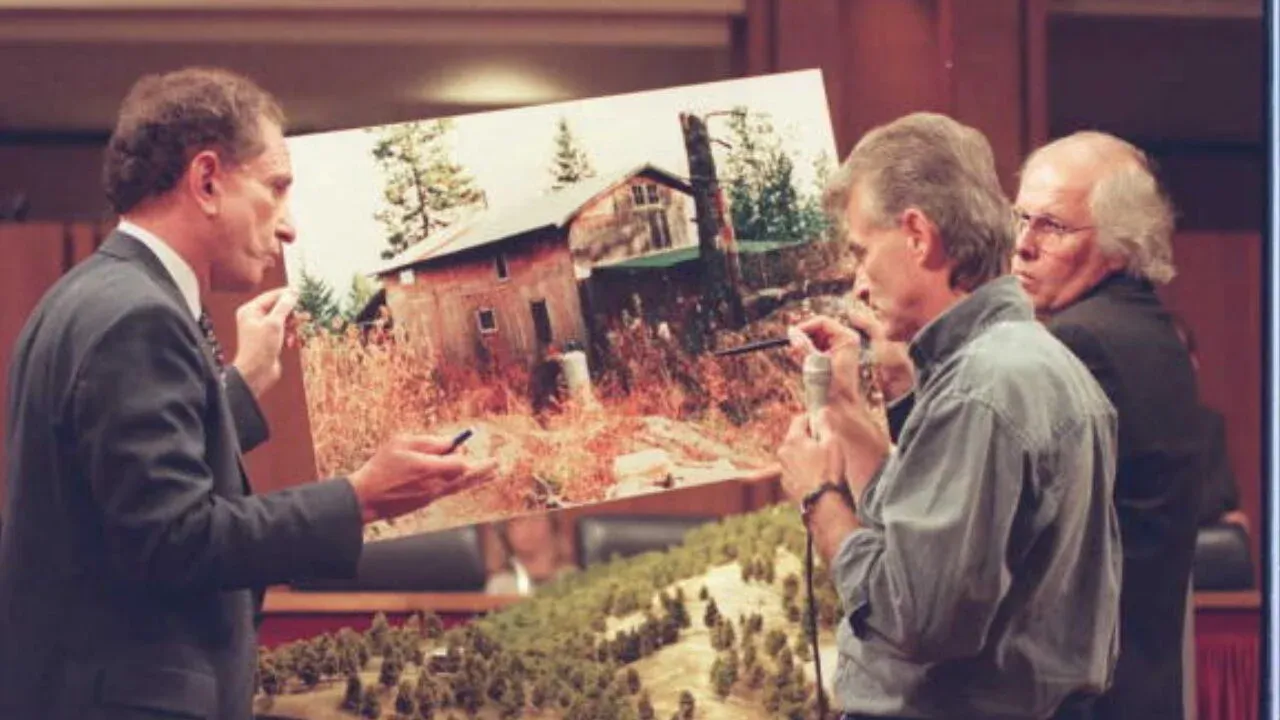
He held racist and antisemitic beliefs. He associated with white-supremacist circles. He spoke about armed resistance against the government. He then sold two illegally shortened shotguns to a federal informant. When federal agents later tried to recruit him as an informant against members of the Aryan Nations, he refused.
He was then indicted on firearms charges.
The state had a real legal problem in front of it.
It also demonstrated, very early, that this problem could be handled without turning the Weaver home into a battlefield.
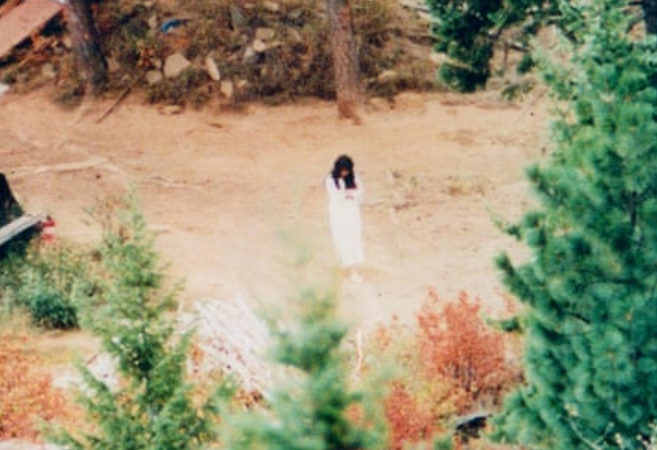
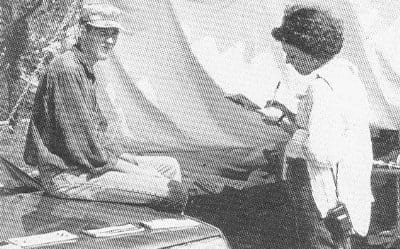
Agents arrested Weaver in January 1991 by posing as stranded motorists. Weaver and his wife stopped to help them. The agents surprised him and took him into custody without a rolling gunfight at the cabin.
This was the field working through ordinary legal transitions.
Then, the dates began to move.
Before the erroneous March 20th date written in the government’s own letter had arrived, prosecutors secured an indictment for failure to appear.
The Justice Department’s later review would find that the U.S. Attorney’s Office had acted with unnecessary rigidity, sought that indictment too early, and failed to tell the grand jury about the mistaken letter.
None of that erased the firearms charge. And none of it required the warrant to vanish.
It did place a very serious burden on the state’s next move.
The state had contributed to the confusion. It knew the subject distrusted it. It knew the family was armed. It knew children lived at the cabin. It knew a direct confrontation could become lethal.
That combination demanded unusual patience and unusually precise correction.
Instead, the legal path began thickening into a tactical one.
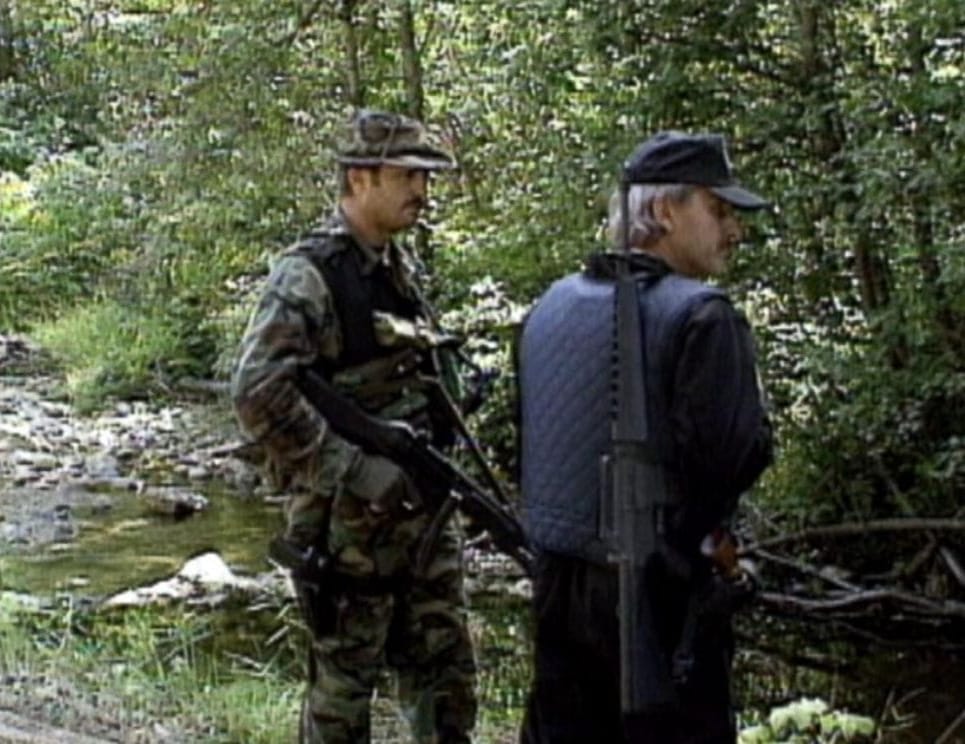
The matter passed to the United States Marshals Service.
The marshals received information about Weaver’s beliefs, weapons, threats, family defensive practices, and refusal to surrender. Weaver said he would not leave the cabin and that officers would have to come and take him. The family described the government through an apocalyptic religious frame. Armed family members, including children, took positions when unfamiliar people or vehicles approached.
These facts were not invented.
They also did not make this family one object.
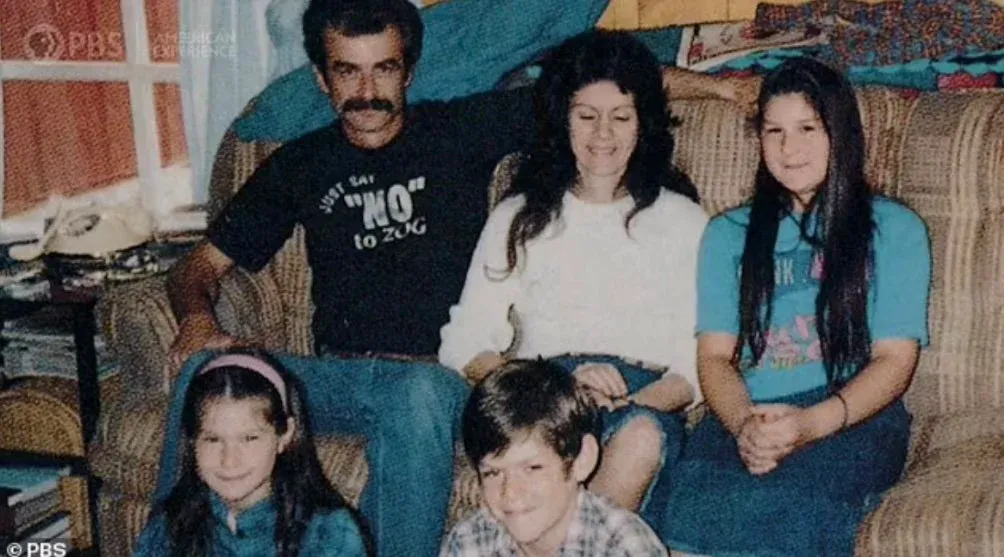
The field still contained an armed fugitive, a wife, children, a family friend, federal agents, intermediaries, lawyers, a disputed court notice, a firearms prosecution, local geography, fear, ideology, and multiple possible surrender routes.
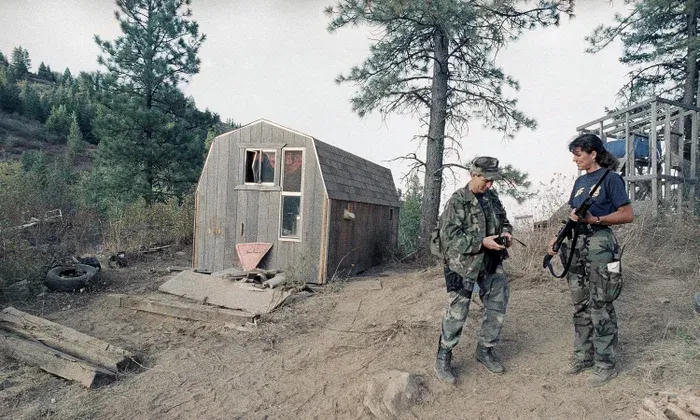
The marshals spent months studying the cabin and trying to avoid a direct assault.
They used intermediaries. They conducted surveillance. They photographed the property from the air. They planned an undercover arrest away from the home because the children’s safety mattered.
This restraint belongs in the account. The field did not move directly from warrant to federal recklessness. Agents understood the danger and tried to preserve a safer route.
Then, on August 21, 1992, six marshals entered the mountain area to survey positions for the undercover operation.
A Weaver family dog, Striker, detected them.
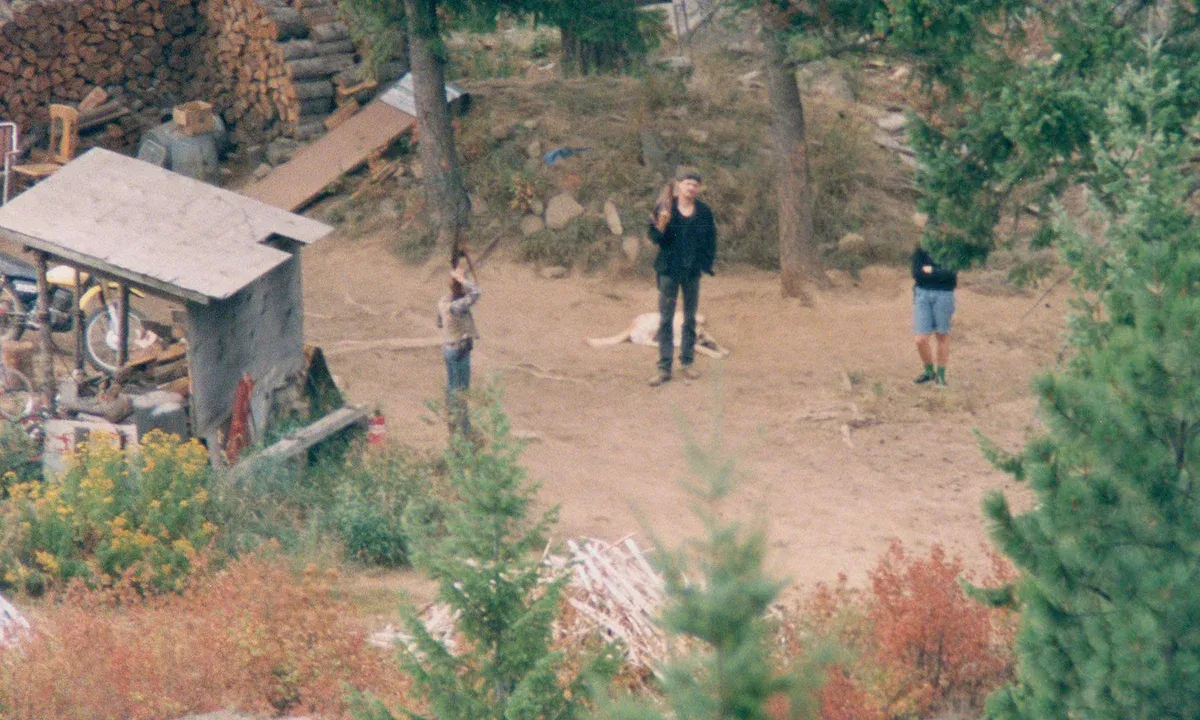
The dog ran toward the marshals. Randy Weaver, his thirteen-year-old son Sammy, family friend Kevin Harris, and some of Weaver’s daughters followed behind. They were armed.
What happened at the trail intersection known as the Y remains disputed in its exact firing sequence.
Now there was a dead federal officer, a dead thirteen-year-old boy, armed people retreating toward the cabin, surviving marshals still in danger, conflicting accounts of who fired first, and a federal institution receiving the news that one of its own had been killed while pursuing a fugitive understood as violently anti-government.
This is the moment the warrant pipeline officially became a retaliation machine.
The death of a law-enforcement officer changes a field immediately.
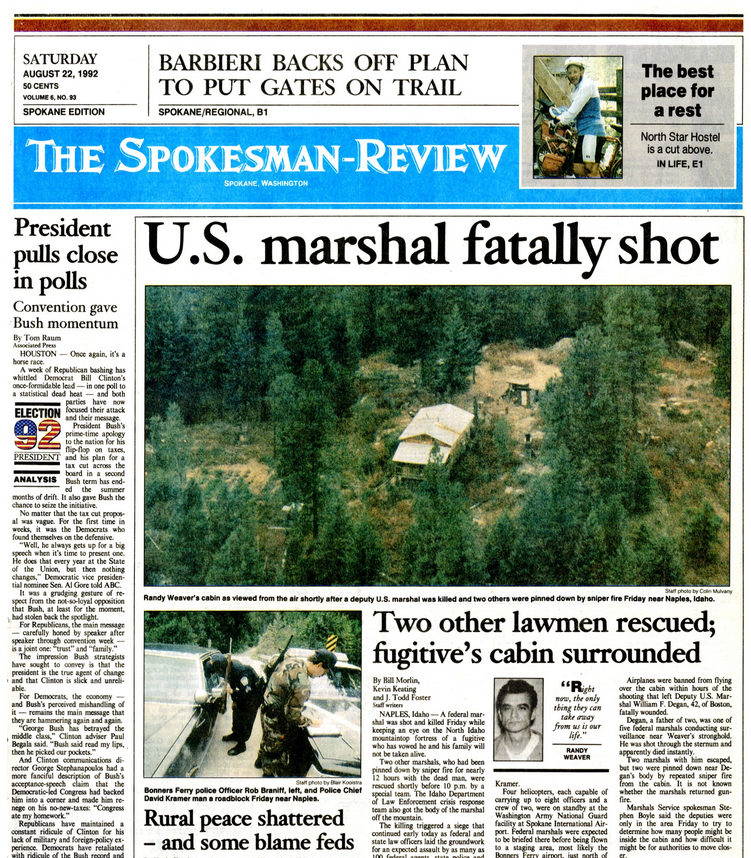
That response is clearly not irrational.
Agents know the dead person. They understand the risk through professional kinship. The institution feels an obligation to recover the body, protect surviving officers, identify the shooter, prevent escape, and establish control before further violence occurs.
An officer’s death also produces a dangerous compression.
The field begins to reorganize around the officer-down signal.
That compression was strengthened at Ruby Ridge by Weaver’s earlier threats, his ideology, his refusal to surrender, and the armed encounter that had already killed Degan.
Those two facts had to remain visible together.
The FBI’s Hostage Rescue Team flew to Idaho. During the flight, senior officials drafted special rules of engagement for the operation.
This is where the state’s analysis became executable.
A rules-of-engagement engine is a decision architecture that converts field classifications into authorized force.
Such an engine does not need software. It can be a policy, a command briefing, an operations plan, a threat category, a trigger condition, an assumption about the subject, or a sentence telling an armed agent what must happen when a specified image enters the scope.
The engine is simple.
At Ruby Ridge, one rule told HRT personnel that if an adult male was seen carrying a weapon before a surrender announcement, deadly force could and should be used when the shot could be taken without endangering children.
Stop right there.
This rule therefore entered a field already arranged to activate it.
This rule did not require the armed man to aim.
It did not require him to fire.
It did not require an immediate threat of death or grievous bodily harm.
It did not require him to know that federal snipers had taken positions around his home.
The classification carried the threat.
This was the state’s own distortion field in clear written form.
The rules took facts that genuinely increased danger and compressed them into a trigger that exceeded the ordinary constitutional limit on deadly force.
The Justice Department’s later review would find exactly that problem. The special rules departed from the FBI’s normal deadly-force policy. Parts of them violated constitutional standards. Their imprecision created misunderstanding. Their atmosphere may have encouraged a sniper to take a shot he otherwise would not have taken.
That language is institutional and careful.
The field was not careful.
That sequence is the whole field failure in miniature.
The state spoke after their sniper had already answered.
A rule can reduce confusion in a dangerous field.
Agents need rules. Commanders need plans. A person carrying a rifle near an armed standoff cannot be safely interpreted with the relaxed innocence appropriate to a person carrying one at a shooting range.
The failure here was not the existence of a rule. It was what this rule made disappear.
The rule did include children as a restraint. That fact reveals the institution’s awareness that this cabin remained a family field.

The same rule then treated the adult men inside that family field as shootable before they had received a surrender demand.
Children were present enough to limit the angle. They were not present enough to prevent the shot.
This is how institutional violence preserves its internal morality while closing the wider field. The instrument retains one visible safeguard and mistakes that safeguard for complete perception.
The children were in the rule. Their family was not.
The FBI then tried to negotiate.
The people inside the cabin did not answer the telephone sent toward them. Weaver later said he believed anyone who stepped outside would be shot.
That belief was not detached from the field anymore.
The government’s communication problem was now partially a product of its own force.
This does not mean Weaver and Harris suddenly became safe, compliant, or trustworthy. It means the state had damaged the credibility of the path it still needed them to take.
Negotiators continued.
Outbuildings were moved. Sammy’s body was discovered.
The siege lasted for days.
The final breakthrough came largely through nongovernmental intermediaries who possessed something the state’s tactical field had lost: enough relational credibility to carry surrender across the gap.
Harris surrendered. The Weavers followed.
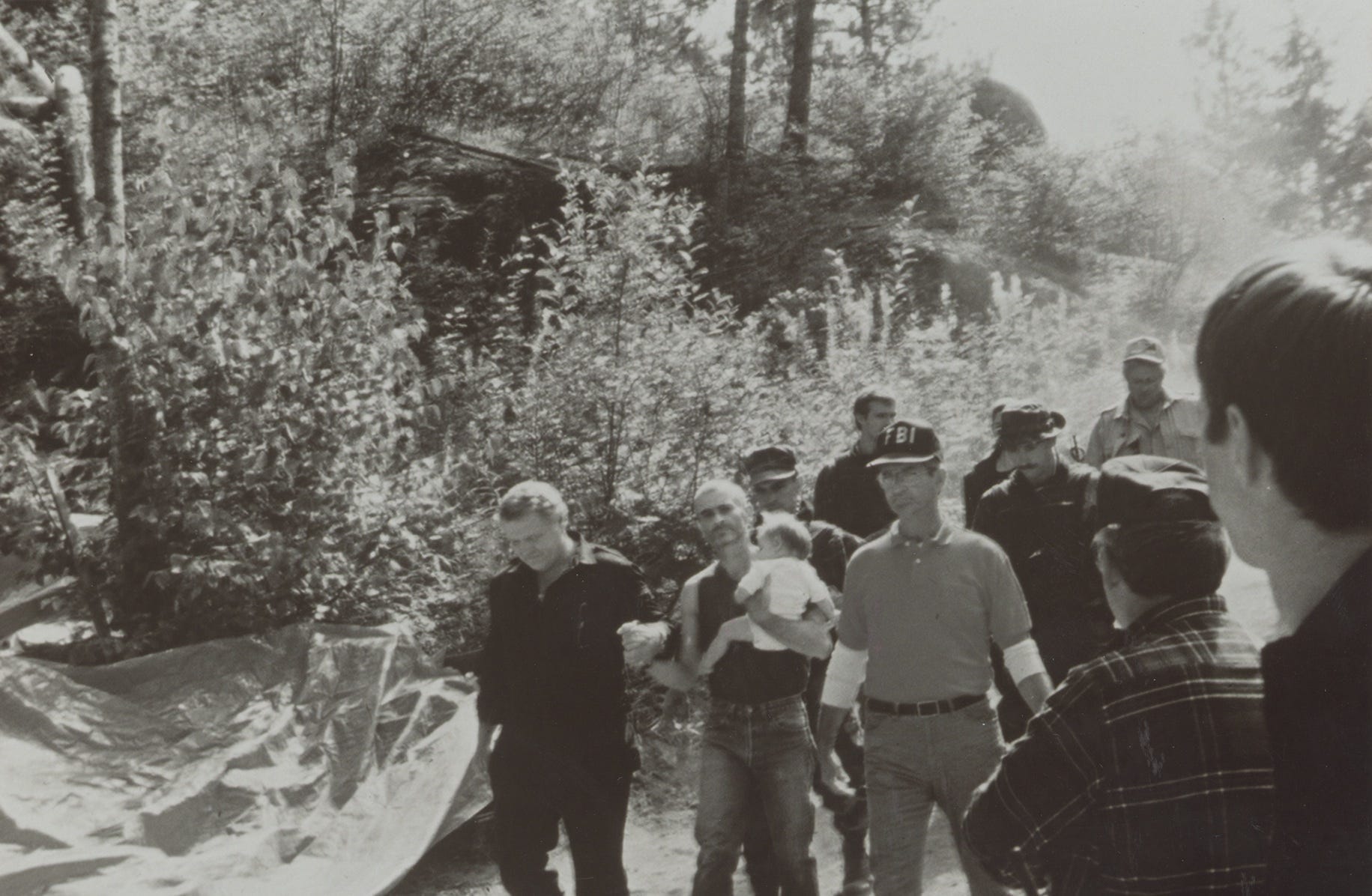
The cabin did not need to be destroyed.
More people did not need to die.
That surviving path demonstrates that even after the firefight, the special rules, the sniper shots, the death of Vicki Weaver, and the deepening siege, surrender remained reachable through a different instrument.
This field had not, in fact, required annihilation.
It had required someone whom the people inside still believed could approach without killing them.
Every failure has to remain visible.
Ruby Ridge was not one pure victim standing against one pure aggressor. This was a sequence of real culpabilities entering the same narrowing field.
The state had the greatest obligation to resist that narrowing because the state possessed law, personnel, intelligence, command structure, time, logistical reach, negotiators, tactical superiority, institutional continuity, and the claimed authority to act for the whole public.
Authority expands responsibility. It does not dissolve it.
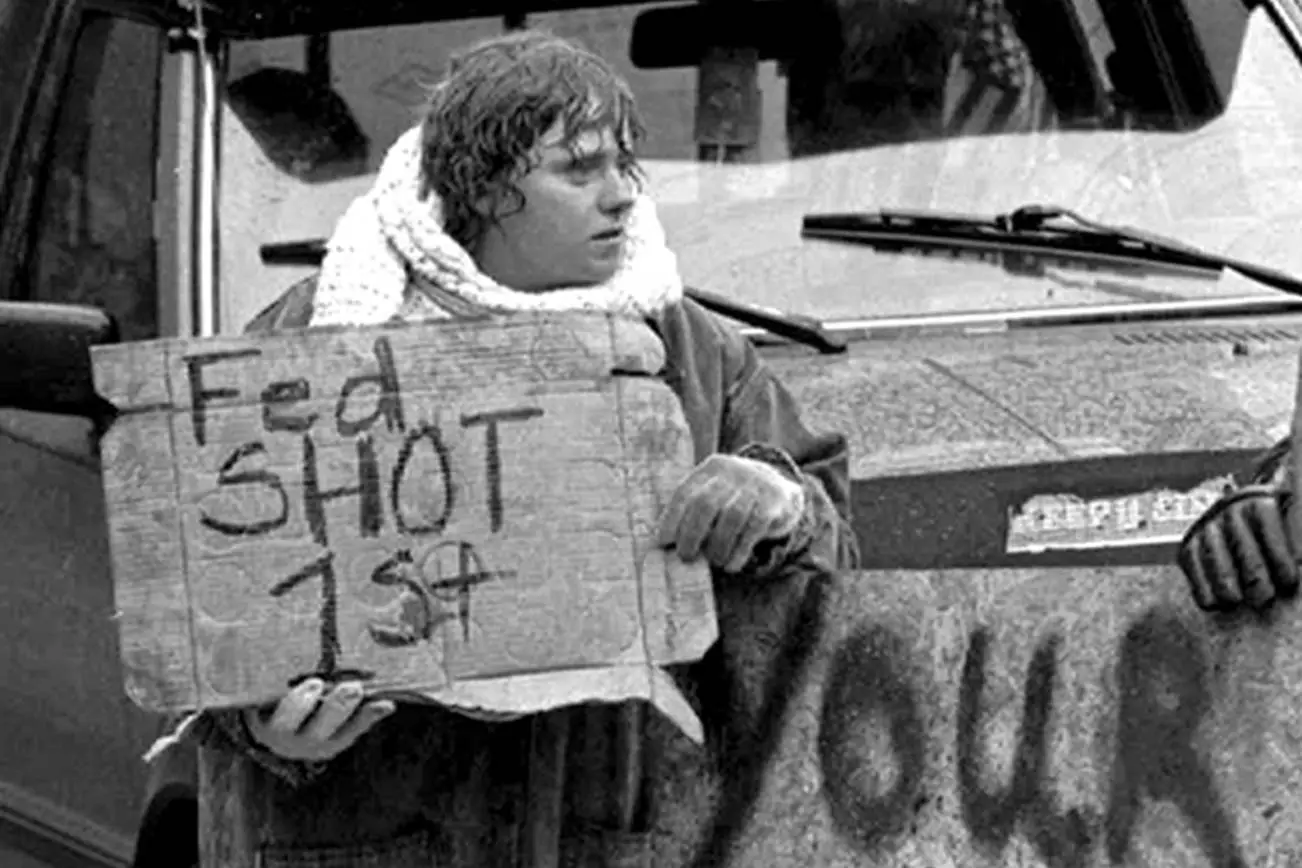
The government was entitled to arrest Weaver.
It was not entitled to let the arrest warrant become whatever the tactical field produced next.
Six months later, federal agents carried another warrant toward another armed religious community.
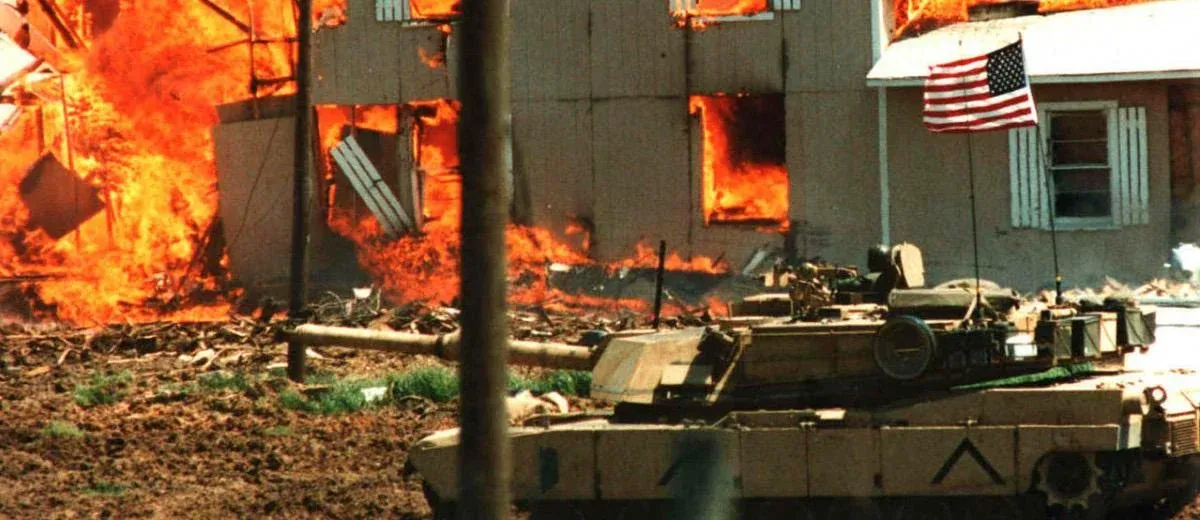
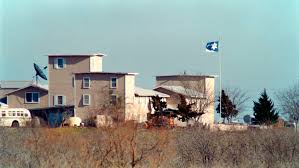
Mount Carmel was larger than the Weaver cabin.
David Koresh’s authority was deeper than Randy Weaver’s control over his household.
The weapons field was larger.
The number of children was larger.
The possibility of organized resistance was obvious.
So was the legitimate need for intervention.

Koresh exercised coercive spiritual and sexual authority over his followers. He took girls as young as the early teenage years as wives. Former members described physical abuse of children. The community accumulated weapons and weapon parts. Federal investigators developed evidence supporting firearms charges and secured warrants to arrest Koresh and search the compound.
Again, the state had a real problem. This one was much worse.

The Branch Davidian field was not a peaceful religious refuge disturbed because federal agents found its theology strange.
These distinctions make state intervention difficult. They do not make it optional.
The question was how the warrants would be served.
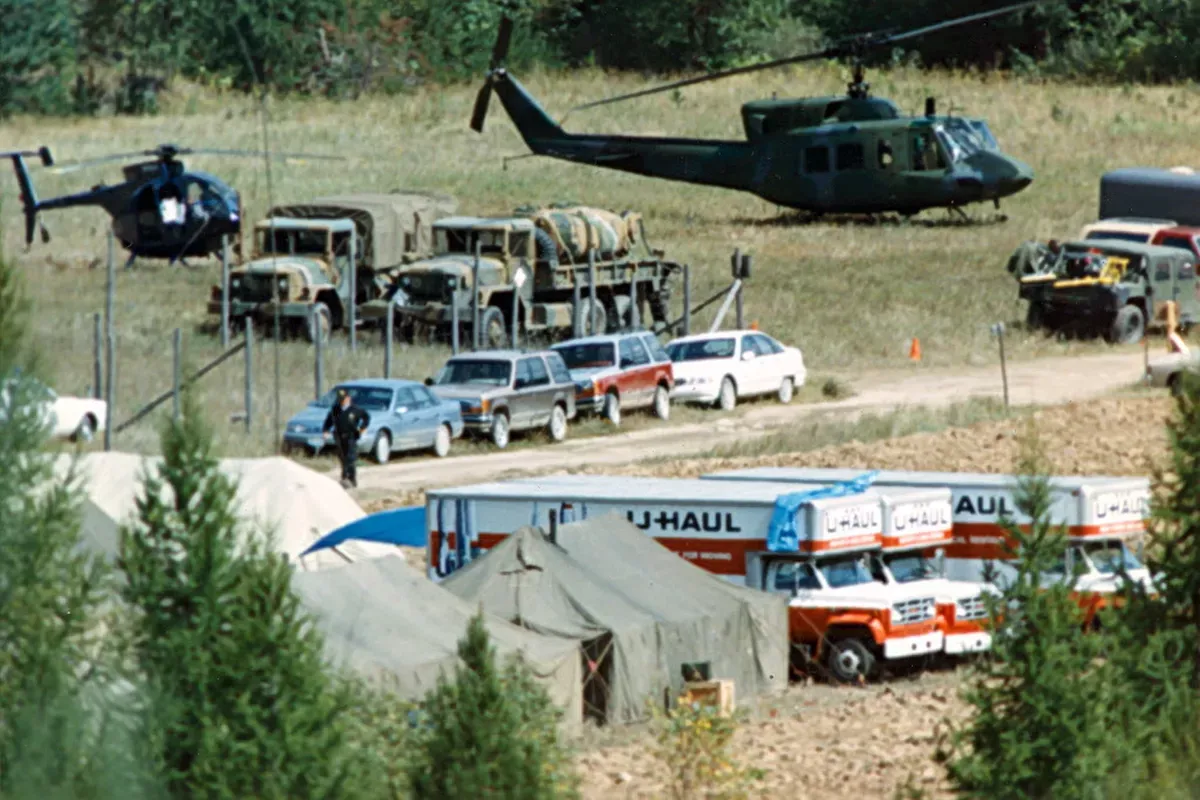
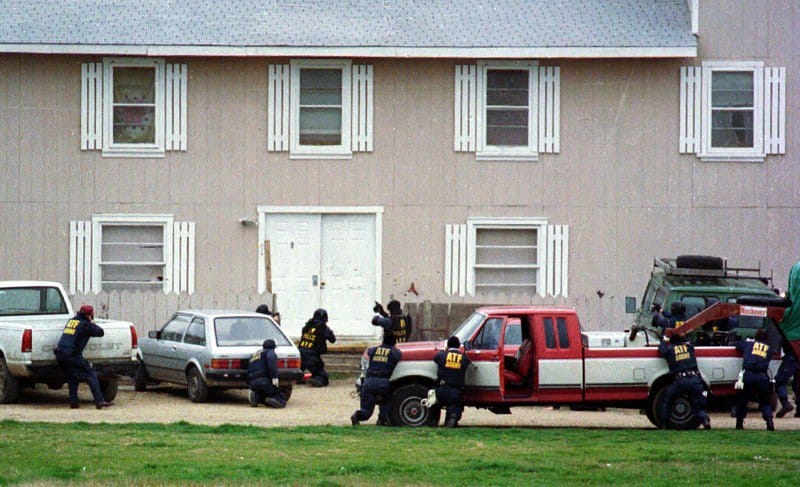
On February 28, 1993, agents from the Bureau of Alcohol, Tobacco and Firearms approached Mount Carmel in cattle trailers.
The operation was designed around surprise, speed, entry, control, and seizure.
Before the agents arrived, signs emerged that the Branch Davidians knew they were coming.
The surprise on which the plan depended had likely collapsed.
The operation continued. Agents reached the building.
Gunfire began.
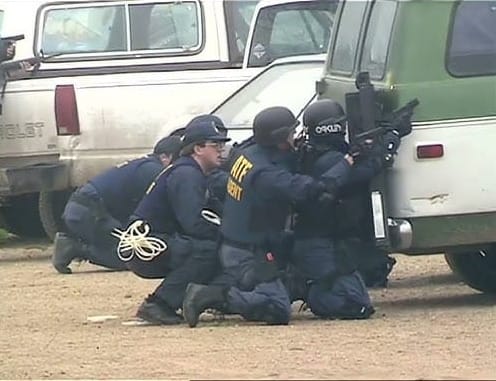
The exact first shot became another contested origin point, fought over afterward by people who understood that the entire moral image of the event might depend on who fired it.
The field did not wait for the historical argument.
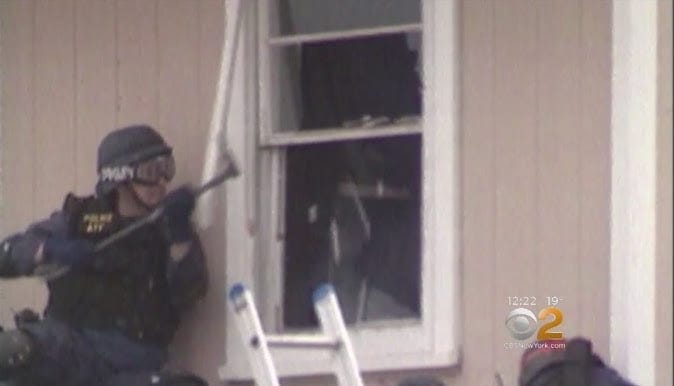
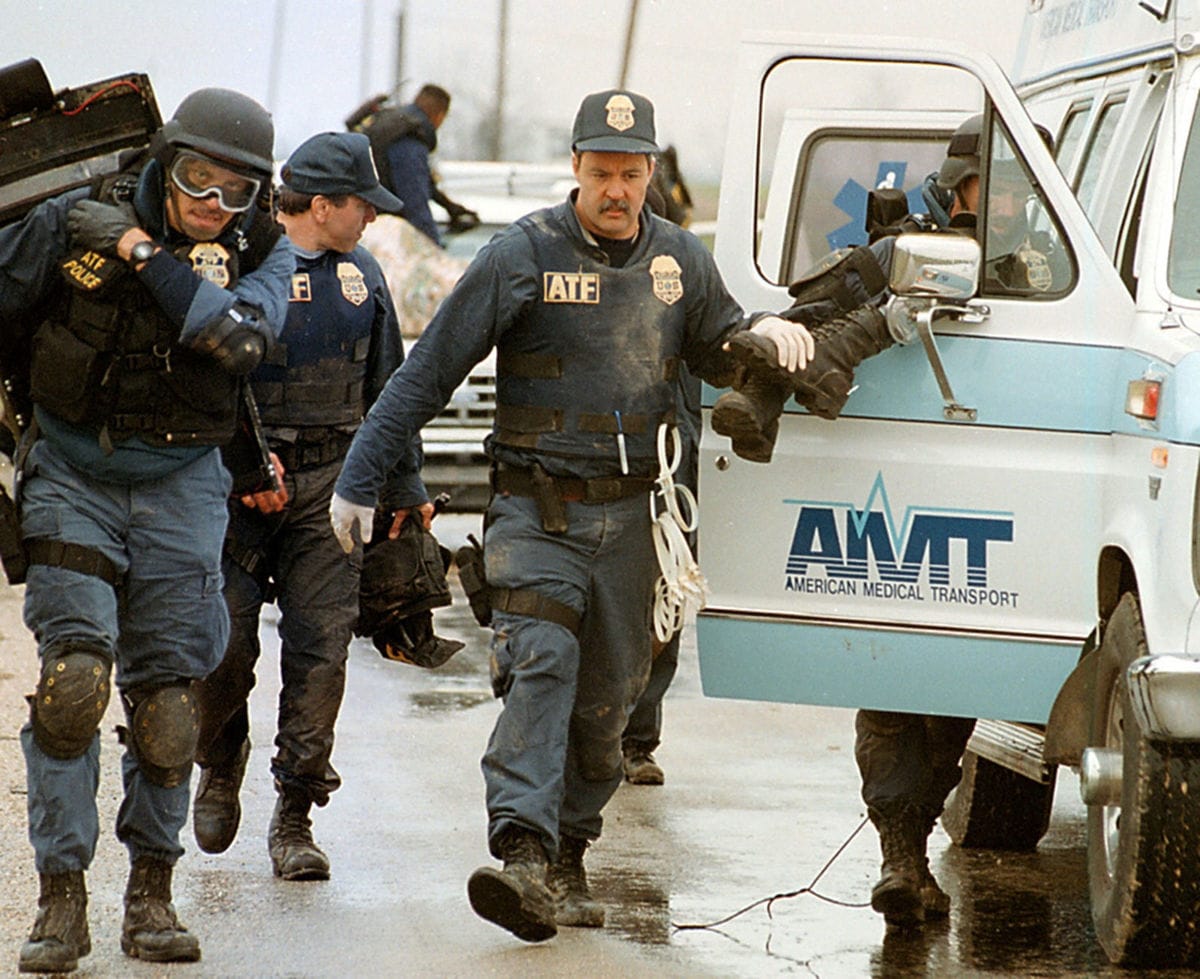
Four ATF agents were killed.
Many more were wounded.
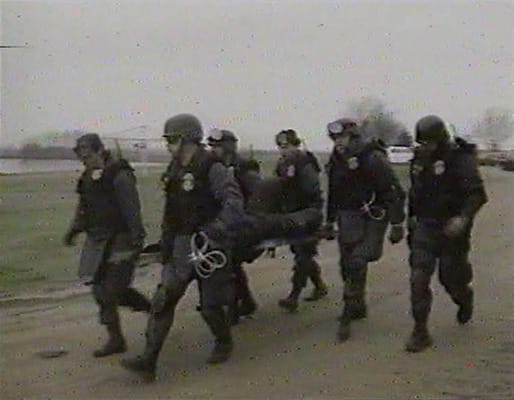
Branch Davidians were also killed and wounded.
The ATF withdrew.
The warrants remained. Now, they were surrounded by blood.
This was the second arrest-warrant-to-siege pipeline.
Every transition changed the next decision.
Each death raised the resistance against retreat.
The raid did not resolve the original problem. It had just rebuilt the problem in a far more dangerous form.
The FBI took command of the standoff.
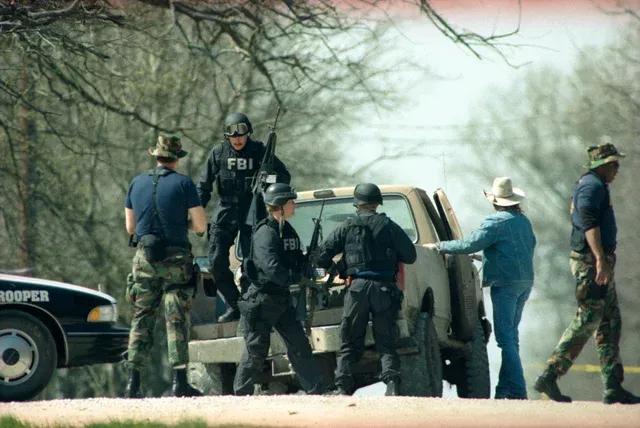
The agency now faced more than one hundred people inside a large building, including children, surrounded by weapons and led by a man whose theology could absorb government pressure as prophetic confirmation.
The ordinary meaning of time changed.
The siege was therefore not one clock ticking down.
It was several incompatible clocks placed around the same building.
The federal government’s central problem was to prevent its clock from becoming sovereign.
Negotiation did produce exits.
During the first six days, twenty-one children and two elderly adults came out. More adults would later leave.
That was not resolution, but it was real path-opening.
Every person who exited represented a piece of the field separated from the final catastrophe.
Negotiators developed communication with Koresh and his lieutenants. They listened through his long religious monologues. They discussed broadcasts, promises, children, scripture, surrender arrangements, food, medical needs, and the conditions under which people might leave.
Koresh repeatedly manipulated these paths.

Nothing about this man's conduct should be softened.

Koresh was one of the principal agents closing this field.
The government still had to decide whether its own instruments would widen the exits or confirm the world he had built.
The FBI did not act as one mind at Waco.
Both strategies responded to real parts of the field.
Neither could simply be removed.
The failure was the absence of a stable architecture capable of making the two strategies answer to one shared objective.
Negotiators saw an opening and wanted to enlarge it. But tactical command saw resistance and wanted to compress it.
Loudspeakers that could have carried useful information were also used to broadcast chants, irritating music, and the sounds of animals being slaughtered.
The pressure had an internal theory.
Make life inside harder.
Except every pressure tactic also entered Koresh’s theology.
The agents saw controlled escalation.
The people inside could see Babylon surrounding the faithful with tanks, darkness, noise, humiliation, and psychological warfare.
The government did not create Koresh’s apocalyptic system.
It began operating inside it.
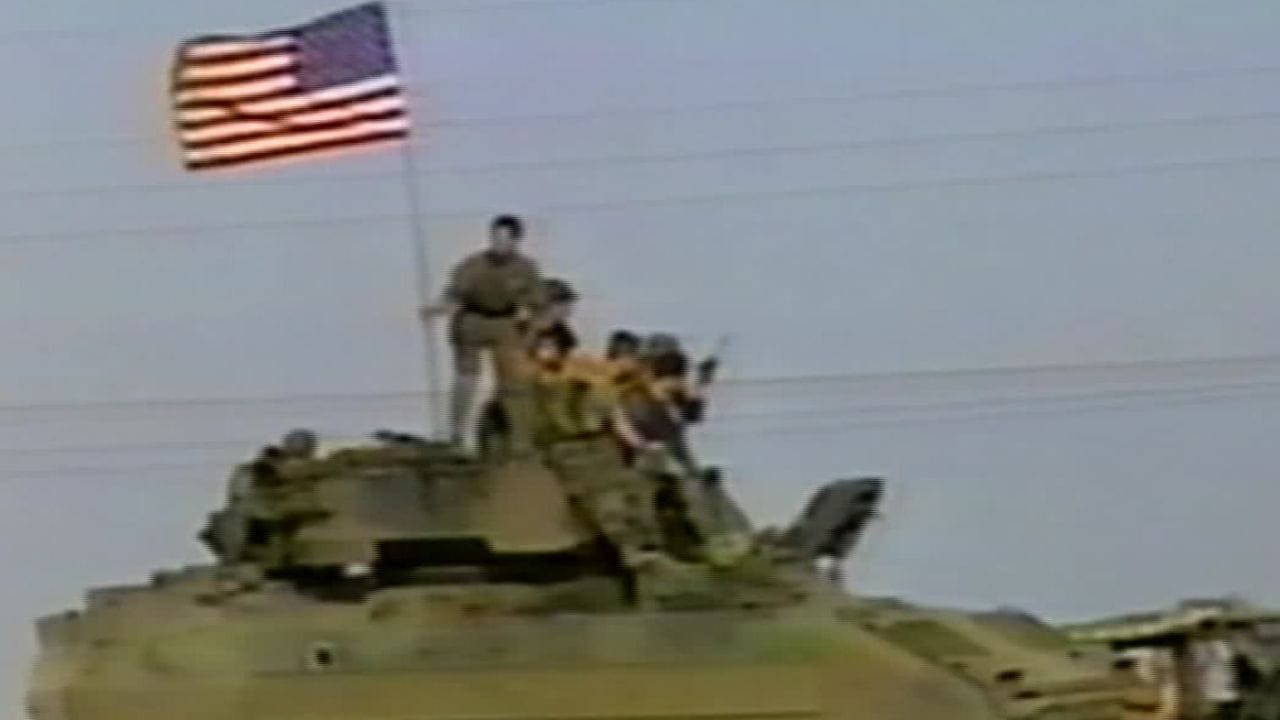
That is a very dangerous thing for a state to do without understanding which actions feed the system and which actions interrupt it.
FBI negotiators objected to several of these tactics. They warned that punishing the compound after people had voluntarily exited taught everyone inside that cooperation did not produce relief. They warned that tactical actions were disrupting progress. They feared that the people inside would conclude that negotiators lacked influence and that the government’s promises could not be trusted.
That conclusion was reasonable. A negotiation channel with no control over the institution behind it is not a full path.
That is a voice asking people to walk into decisions made somewhere else.
A siege produces intense pressure to confuse visible activity with movement.
Command can point to each action and show that the institution is doing something.
Except the field may still be closing.
Pressure can produce surrender.
Pressure can also increase internal cohesion, validate persecution narratives, elevate the authority of the leader who predicted the persecution, and convince uncertain followers that the outside actor has confirmed the group’s account of reality.
This is why pressure must remain subordinate to field intelligence.
At Waco, tactical pressure repeatedly overruled or outran the agents closest to the communication path.
That did not make negotiation certain to succeed. Koresh had already broken major promises. Some followers appeared ready to die with him. He retained control over children and over a heavily armed community organized around his authority.
Negotiation might never have produced full surrender.
It had already produced living people outside the building.
That fact should have given preservation more institutional weight than it received.
By April, federal decision-makers increasingly believed Koresh would not surrender.
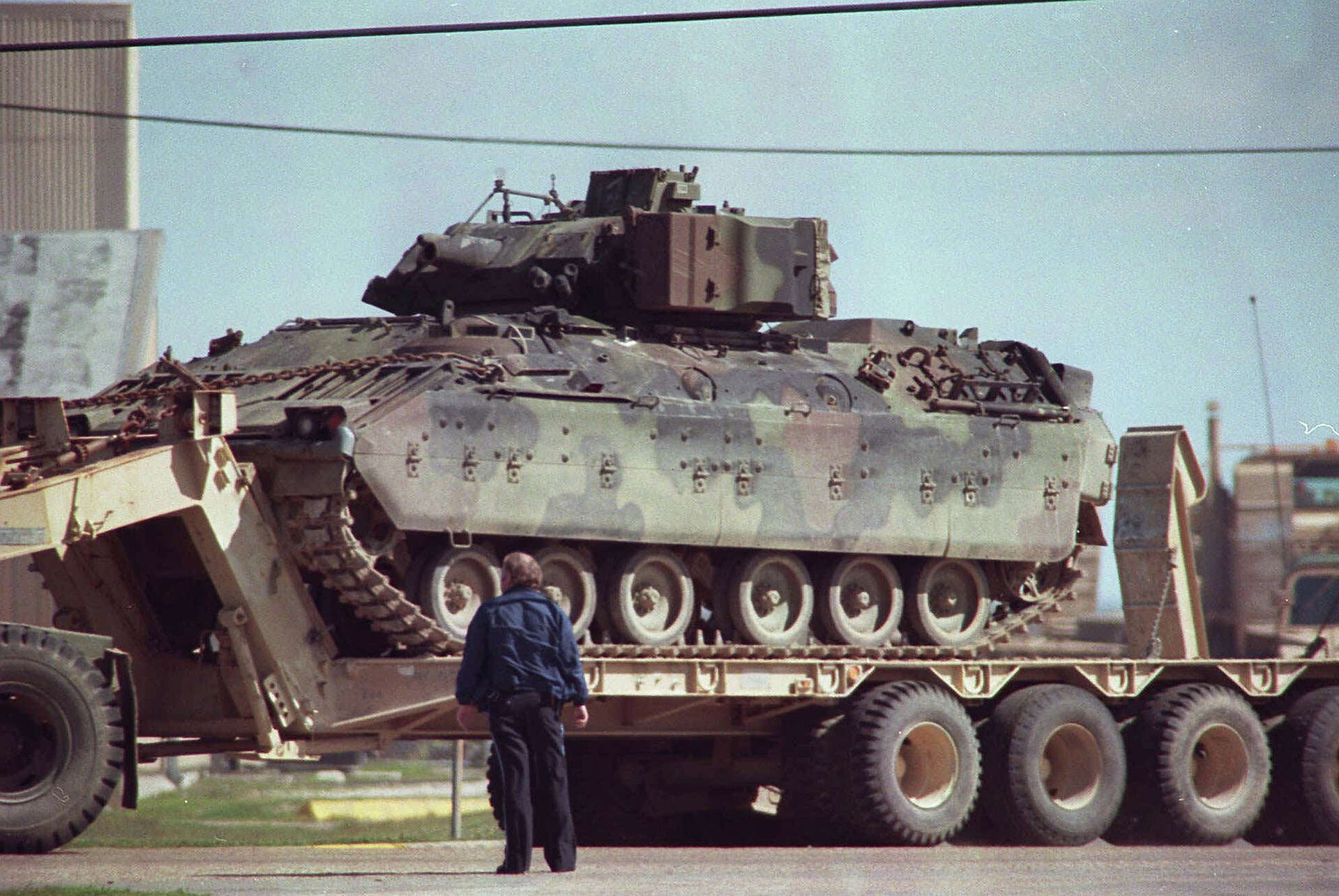
So a plan was approved to insert CS gas into the building using armored vehicles.
The stated plan was incremental. It could take two or three days.
The gas would make the building increasingly difficult to occupy and push people toward exit.
The plan also contained a branch:
If the Davidians fired on the vehicles, the operation could escalate immediately. Gas would be inserted throughout the compound. Breaches would expand. The slow plan would become a faster one.
This is another rules-of-engagement engine. The trigger was very foreseeable.
The compound was occupied by armed people who had already exchanged prolonged gunfire with federal agents and interpreted armored movement as attack.
The plan placed armored vehicles against the building and defined gunfire in response as the condition for immediate escalation.
Then, the field activated the rule.
That restraint must remain clearly in the account.
Federal agents spent hours under gunfire and did not answer with bullets.
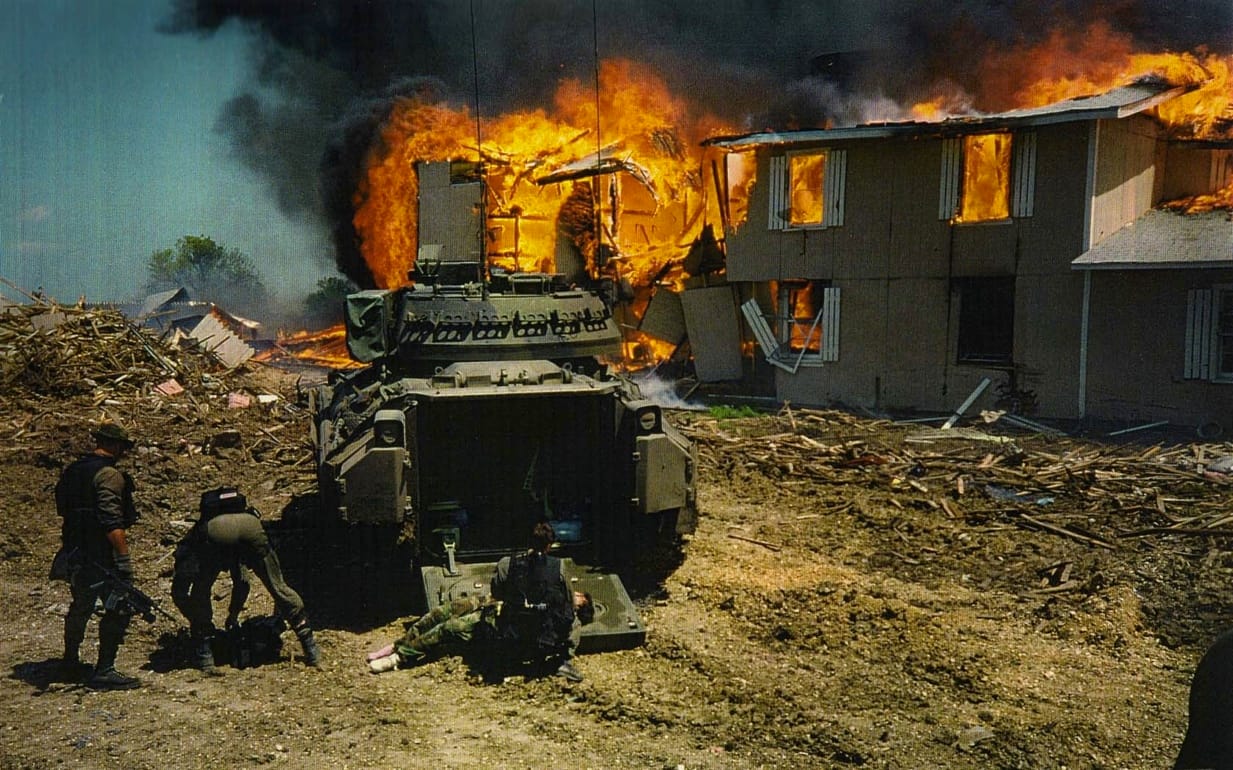
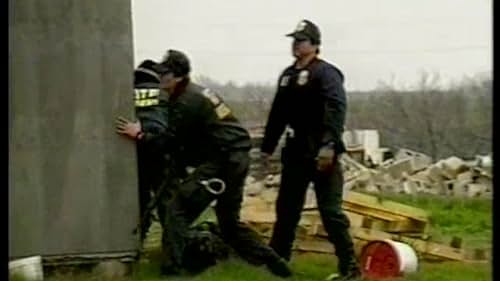
Armored vehicles punched openings into the building and inserted gas. Ferret rounds entered through windows. The plan that had been described as a process of days moved rapidly through the structure during the morning.
The semantic distinction belonged to the operations plan.
The physical field carried a very different message.
It is easy to judge the final operation by asking whether agents followed the approved plan.
They did.
Except that is not enough.
A rules engine carries moral content in its design.
At Ruby Ridge, the engine converted an armed adult male into a permissible sniper target before surrender was announced.
At Waco, the engine converted gunfire against armored vehicles into accelerated gas insertion and structural breaching across a building occupied by adults and children.
The two operations were not equivalent.
The shared structural problem lies deeper than equivalence.
In both cases, the state designed an operational field around anticipated hostile behavior, then treated the arrival of that anticipated behavior as authorization for the next escalation.
An institution cannot escape responsibility for the path by pointing to the condition it built the path around.
The machine followed the rules. That is what machines do. That is why the rules require judgment.
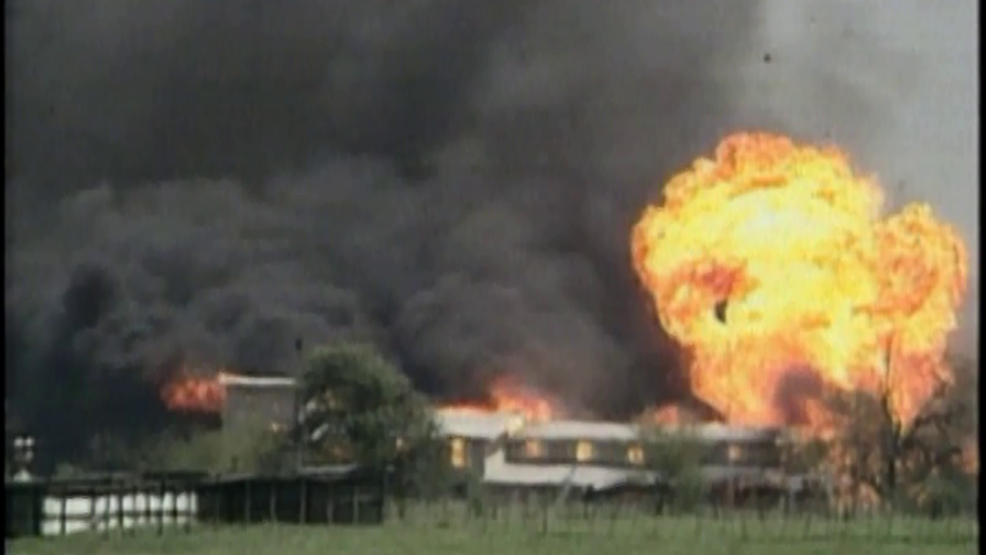
Around noon, fires began inside Mount Carmel at several locations.
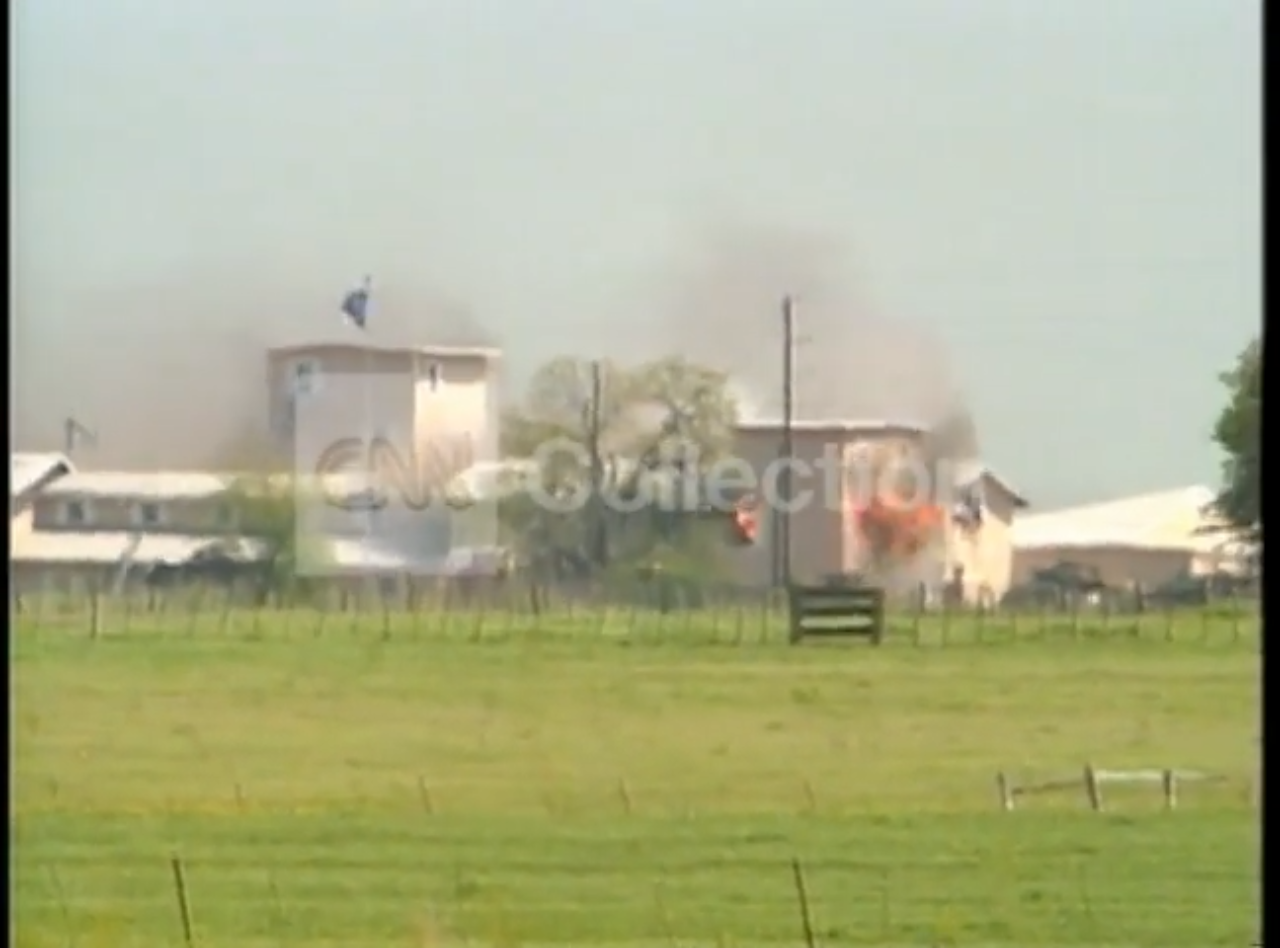
The official investigations concluded that the fires were deliberately set from within the compound.
The FBI’s gas systems did not ignite them.
Federal agents did not fire their weapons during the final operation.
Some of the dead had been shot.
Children were among those killed by gunfire.
One young child was stabbed.
The available evidence shows that people inside the compound participated in killing others as the field ended.
These facts belong directly at the center.
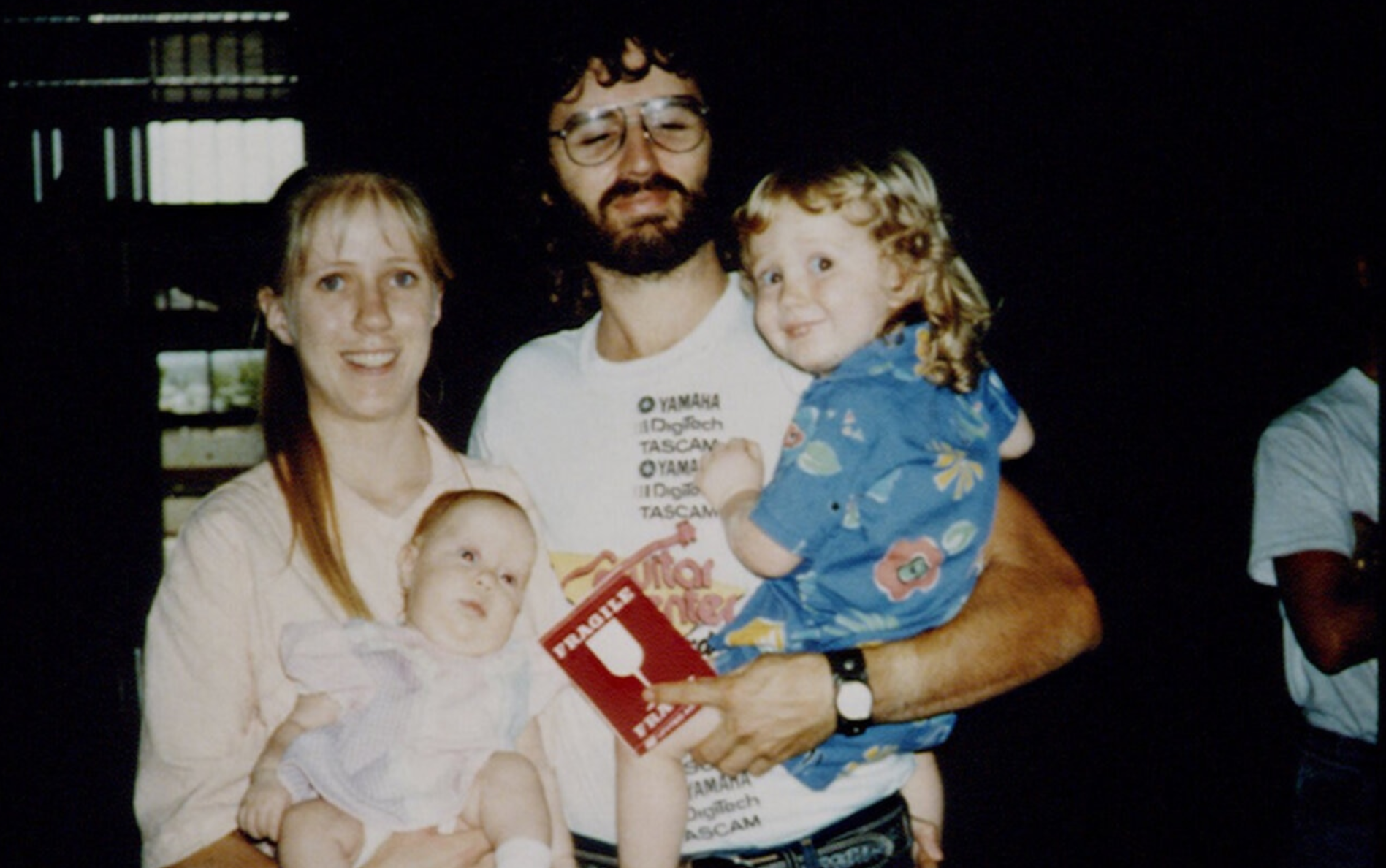
Koresh and members of his inner circle were not inert objects upon whom the government wrote the ending.
They retained agency.
They had guns.
They had fuel.
They had control over children.
They received repeated instructions to leave.
Some people did escape once the fire began.

Others were killed, remained, were held, obeyed, or chose death inside a structure controlled by Koresh and his lieutenants.
The government did not set the fire.
The government still owned all of its decisions before the fire.
Both failures stand. Neither one pays for the other.
David Koresh was an abusive religious sovereign.
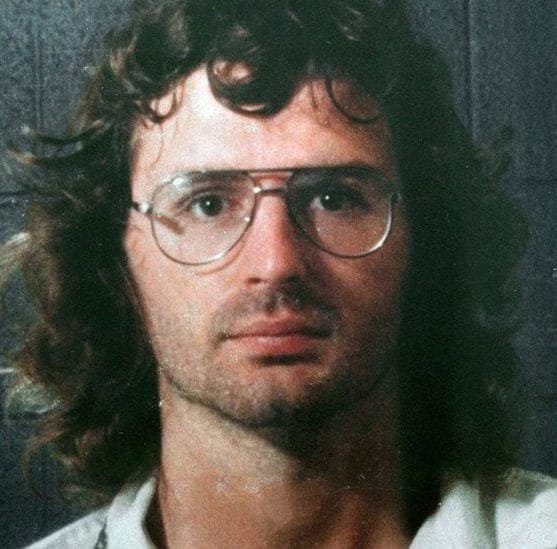
The federal government also failed.
This ruling does not require the fantasy that every person could certainly have been saved through patience. It requires recognition that the state’s obligation was to preserve every still-reachable exit for as long as the costs of doing so remained proportionate.
Instead, its machinery entered the revelation with him.
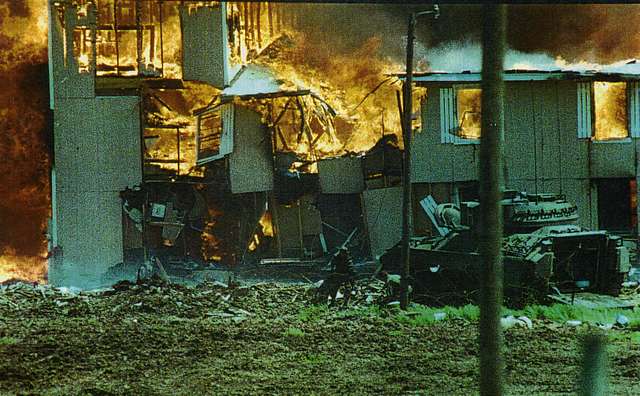
Ruby Ridge and Waco were very different events.
McVeigh and the militia movement compressed them into one clean story because clean stories are portable.
The actual shared structure is more precise and less sharable.
This is the arrest-warrant-to-siege pipeline.
The pipeline does not mean law enforcement should abandon armed warrants.
This means the state must identify the moment when its own method begins manufacturing the resistance used to justify the next method.
That is extremely difficult. It is also this job.
The dead could not be restored. Repair had to begin with institutional exposure.
Aborting a raid does not cancel a warrant. Changing tactics does not surrender law. Waiting does not always mean weakness.
A state powerful enough to act must also be powerful enough to stop its own action without experiencing correction as defeat.
Ruby Ridge and Waco exposed institutions that had trouble preserving that path.
The proper response was investigation, doctrine, oversight, compensation, discipline, public truth, operational reform, legal challenge, and the long unglamorous construction of a state less likely to repeat the same closure.
Timothy McVeigh chose something else.
McVeigh did not own Ruby Ridge. He did not own Waco.
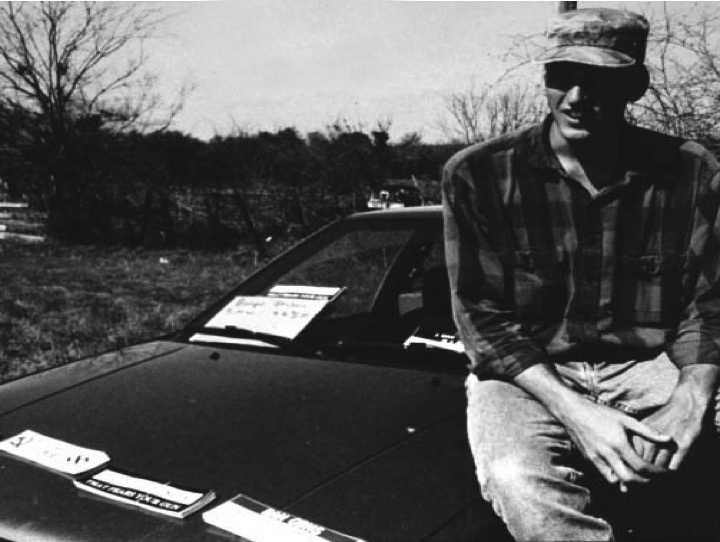
The dead were not his political property.
The surviving families had not appointed him.
The children inside Mount Carmel had not transferred their interrupted futures into his hands.
The failures belonged to a real repair field containing victims, survivors, investigators, lawyers, juries, journalists, legislators, federal employees, civil-liberties advocates, law-enforcement personnel, religious scholars, tactical specialists, and citizens trying to determine how lawful authority had become catastrophe.
McVeigh extracted the wound from that field.
He stripped away every person with standing to correct it.
He removed every slow institutional path.
He removed every disagreement about facts.
He removed the distinction between ATF, FBI, prosecutors, commanders, agents, courts, and elected officials.
He removed the distinction between the people who made decisions and the people who just happened to work inside another federal building.
Waco became one word. Federal became one body.
April 19 became a command.
That was his theft.
McVeigh took a wound suffered by others and converted it into personal authority over people who had not caused it.
Then, he spent his counterfeit token.
A retaliation machine forms when a wound is converted into permission, permission is converted into target selection, and the target is insulated from the living field by symbolic accounting.
The machine begins with injury.
All of those things may be true.
The machine then performs its decisive conversion:
Someone must pay.
That sentence feels like movement.
It is usually analytical surrender.
The placement does not need to reach the original agent. It only needs a body capable of carrying the message.
This is why retaliation loves symbols.
The symbol solves the machine’s hardest problem:
Reality contains too many distinctions.
The symbol makes substitution easy.
McVeigh needed the Murrah Building to become The Federal Government because the actual federal field was too wide, distributed, varied, and living for him to attack as one thing.
This building provided local walls around the abstraction.
Then the bomb opened those walls and found people.
The Murrah Building housed federal agencies.
It did not contain one gestalt federal organism.
The people inside did not share one decision-making role.
They had not jointly written the rules of engagement at Ruby Ridge.
They had not planned the ATF raid at Waco.
They had not approved the gas operation.
They had not become morally interchangeable because their salaries passed through federal accounts.
Some processed benefits. Some enforced regulations.
Some handled housing programs.
Some worked in recruitment, agriculture, transportation, veterans’ services, drug enforcement, or administrative support.
Some were just visiting.
Some were still too young to read the agency names on the lobby directory.
McVeigh’s analysis required all roles to disappear.
This is the same failure found in every field of collective punishment.
A real institution is cut into one moral body so that force can be applied without the resistance of individual innocence.
McVeigh called this a strike against government.
Except the bomb did not encounter “government.”
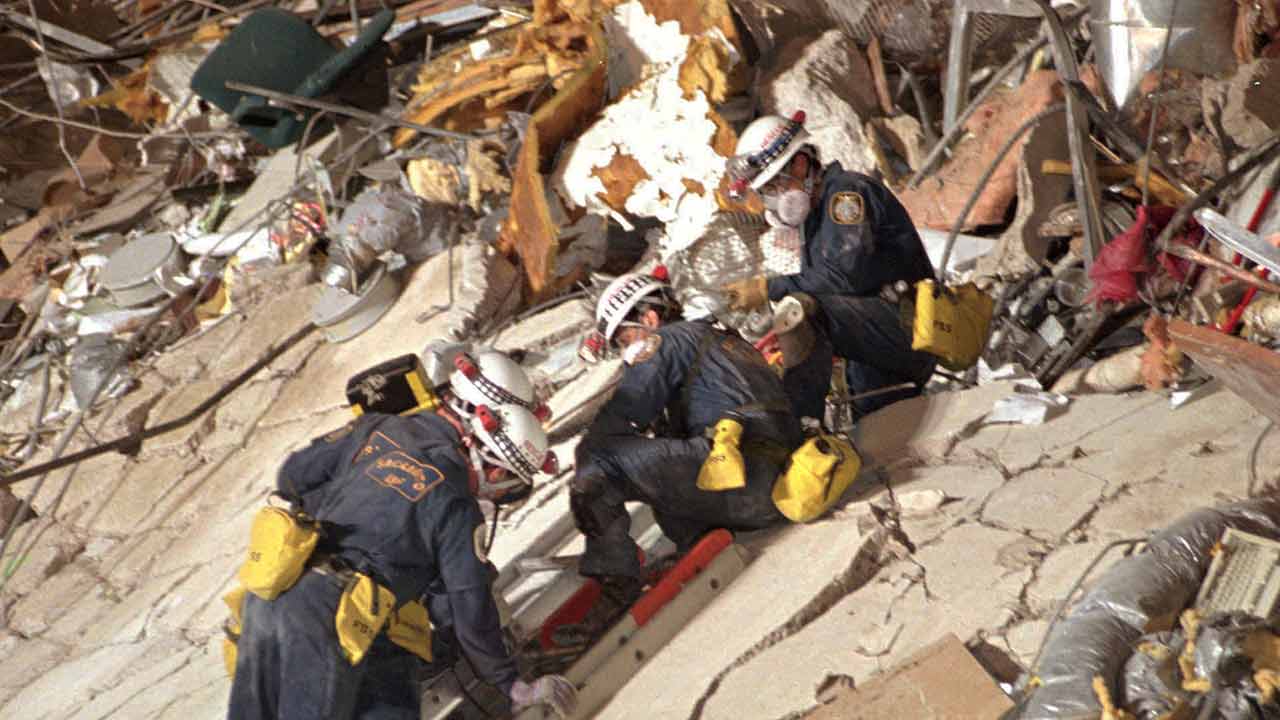
It encountered bodies at work.
McVeigh selected this date deliberately.
The bombing occurred two years after the final day at Waco. The date was supposed to bind these fields together.
Dates can preserve memory.
Dates can orient mourning.
Dates can demand investigation.
Dates cannot transfer culpability.
April 19th did not carry Waco’s decision-makers into the Murrah Building.
It did not make Oklahoma City an extension of Mount Carmel.
McVeigh needed the date to perform that false metaphysical continuity because retaliation depends on taking a moral shortcut through time.
This is a civic form of sacred title.
The revolution, the Constitution, the militia tradition, the martyrs, the tyrants, Lexington and Concord, Ruby Ridge, Waco:
All are assembled into a past that commands the present.
McVeigh treated history as inherited targeting authority. The dead had become his orders.
McVeigh understood the first group as evidence against the federal government.
He accepted the second group as a cost of striking it.
That conversion rules the entire case.
This is what retaliation does to innocence.
That is the kind of exchange rate Modal Path Ethics refuses.
The child is where symbolic warfare is forced to confess what it believes.
McVeigh believed the target was important enough.
McVeigh believed he was answering state force with revolutionary force.
Structurally, he copied the exact closure he claimed to oppose.
The government’s failures and McVeigh’s bombing were not equivalent in law, authority, intention, procedure, or scale.
They shared a deformation.
McVeigh did not oppose the Retaliation Machine.
He privatized it.
What became reachable after Oklahoma City?
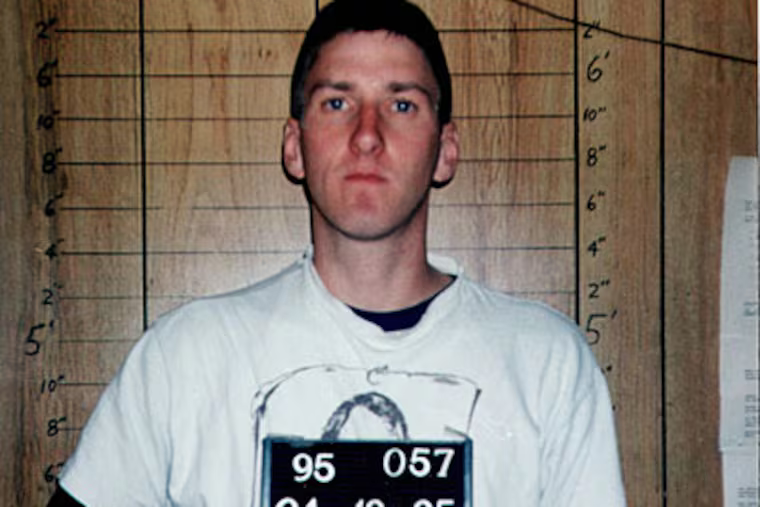
His revolutionary blow ended with him inside federal custody.
The machine absorbed him easily.
Retaliation often strengthens the target’s most coercive functions.
A competent field analyst in McVeigh's position angry about Ruby Ridge would ask how, exactly, a confused firearms prosecution became a siege.
A competent field analyst angry about Waco would ask how an arrest and search operation became a fifty-one-day apocalyptic field ending in mass death.
These questions would be specific.
These questions lead toward doctrine, oversight, law, evidence, accountability, training, compensation, negotiation capacity, command reform, civilian review, investigative journalism, congressional pressure, litigation, and patient institutional design.
That work is slow and boring. It is vulnerable to compromise.
It rarely ever produces the emotional clarity of an explosion.
It can fail.
But that is still where repair lives.
McVeigh did not pursue a difficult path toward a less violent state.
He just built a truck bomb.
Timothy McVeigh was a failed field analyst.
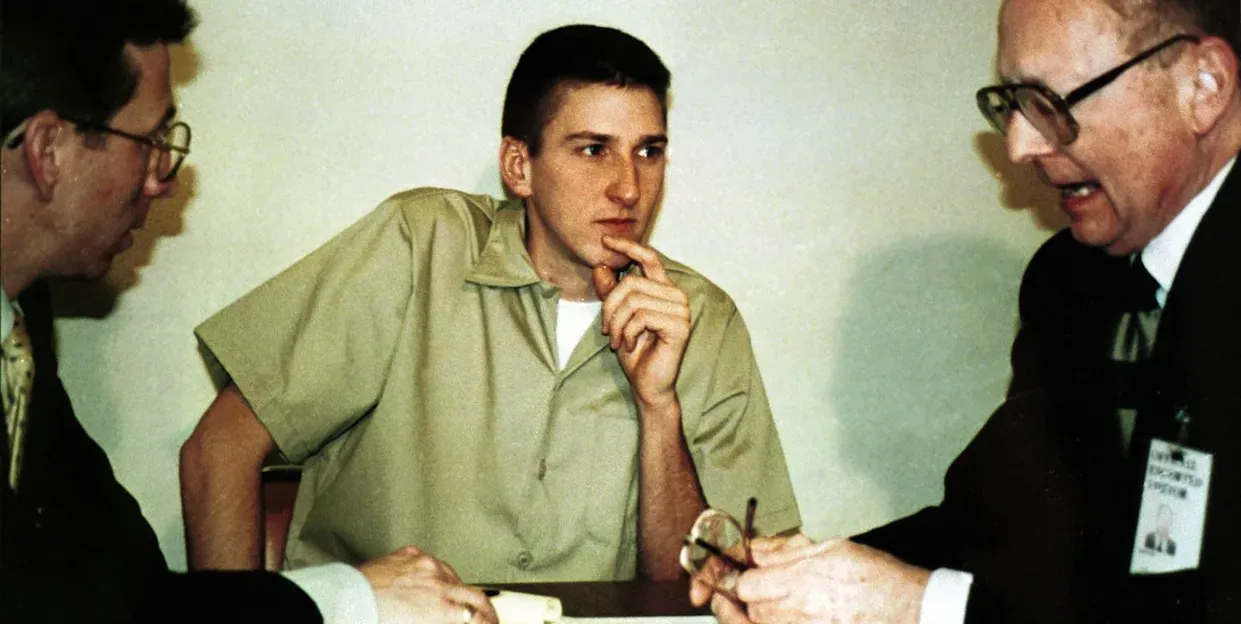
Then, he failed every moral test that followed.
McVeigh took a real state failure and converted it into private sovereignty.
Timothy McVeigh claimed to answer the Retaliation Machine.
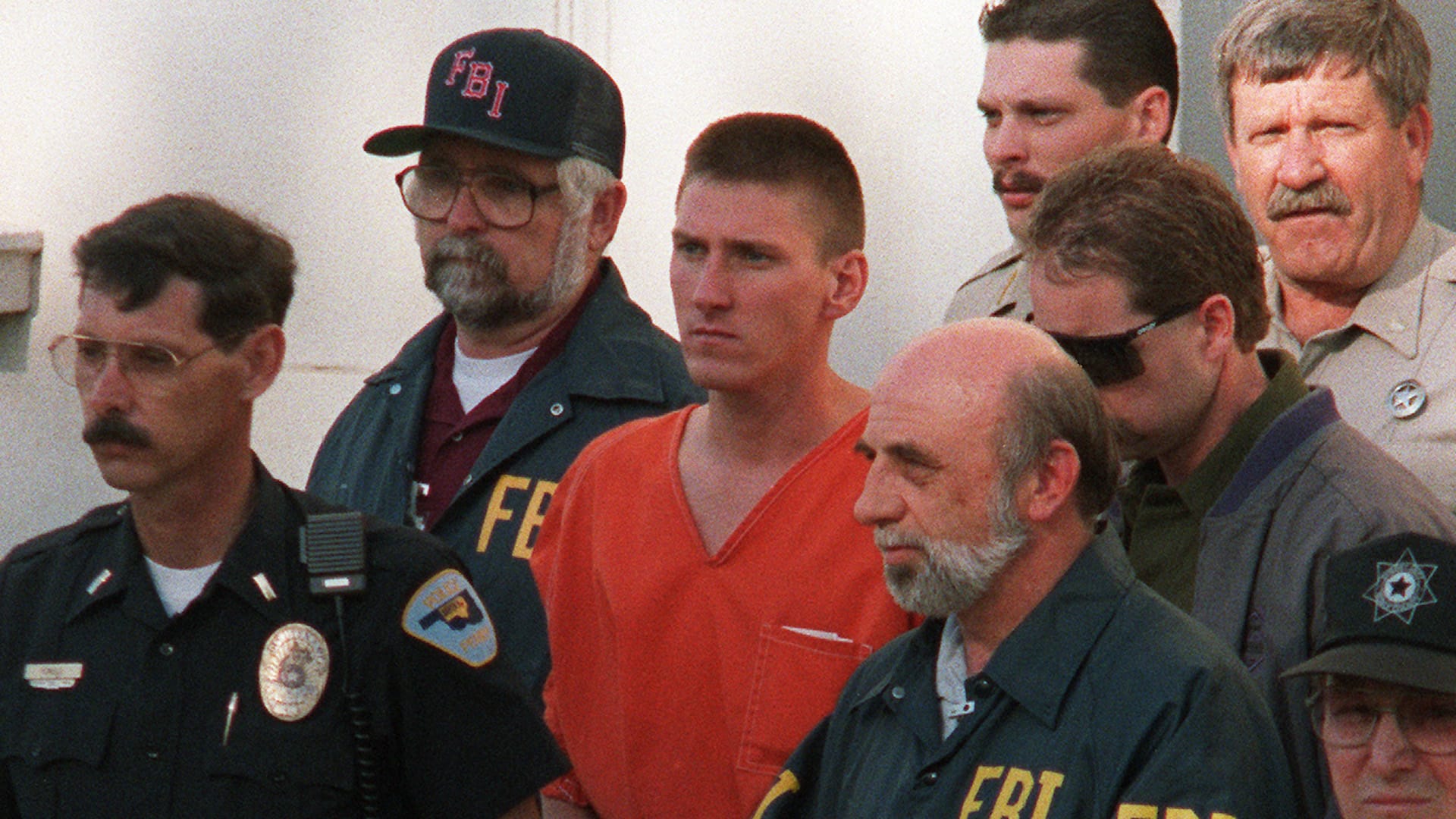
He only proved that it had successfully reproduced itself.